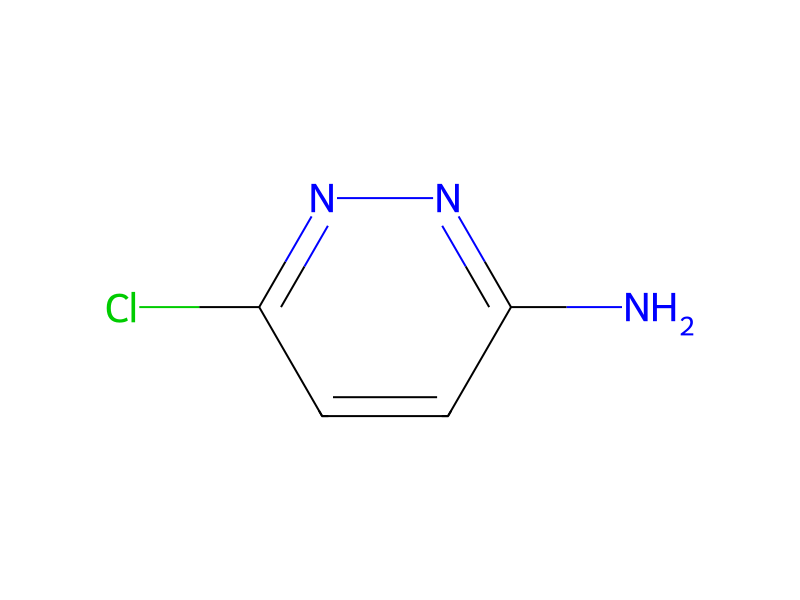
6-Amino-3-chloropyridazine → HCID 68261078, compound
Reaction equation

Cl[C:2]1[N:7]=[N:6][C:5]([NH2:8])=[CH:4][CH:3]=1.[C:9]([O:13][C:14]([N:16]1[CH:21]2[CH2:22][CH2:23][CH:17]1[CH2:18][NH:19][CH2:20]2)=[O:15])([CH3:12])([CH3:11])[CH3:10]>ClCCl>[C:9]([O:13][C:14]([N:16]1[CH:17]2[CH2:23][CH2:22][CH:21]1[CH2:20][N:19]([C:2]1[N:7]=[N:6][C:5]([NH2:8])=[CH:4][CH:3]=1)[CH2:18]2)=[O:15])([CH3:12])([CH3:10])[CH3:11]Participants
4
Reactant 2

Product 1

Reagents, catalysts & solvents 1

Conditions
- Temperature
- 130 °C
Procedure
In a mortar and pestle 6-chloro-pyridazin-3-ylamine (100 mg, 0.772 mmol) and 3,8-diaza-bicyclo[3.2.1]octane-8-carboxylic acid tert-butyl ester (180 mg, 0.849 mmol) were grounded together, placed in a sealed tube and heated to 130° C. for 16 h. The reaction was allowed to cool to room temperature and then the contents were dissolved in a minimal amount of dichloromethane. The crude product was purified by silica gel chromatography using a 0-50% ethyl acetate heptane gradient which gave 3-(6-amino-pyridazin-3-yl)-3,8-diaza-bicyclo[3.2.1]octane-8-carboxylic acid tert-butyl ester (70.7 mg, 0.232 mmol) in 30% yield.
Workup
- customplaced in a sealed tube
- temperatureto cool to room temperature
- customThe crude product was purified by silica gel chromatography
Sources & evidence
- ORD record
- ord-31207536dbe3456da10221a8bf31f497
- Source dataset
- uspto-grants-2015_02
- Patent number
- US08957074B2
Reaction notes
Loading…