Diisopropylethylamine → 5-(3-((2-(1,2,4-oxadiazol-3-yl)propan-2-yl)carbamoyl)-4-methoxyphenyl)-2-(4-fluorophenyl)-N-methyl-6-((2,2,2-trifluoroethyl)amino)furo[2,3-b]pyridine-3-carboxamide
Reaction equation

CN(C(ON1N=NC2C=CC=NC1=2)=[N+](C)C)C.F[P-](F)(F)(F)(F)F.[F:25][C:26]1[CH:31]=[CH:30][C:29]([C:32]2[O:57][C:35]3=[N:36][C:37]([NH:51][CH2:52][C:53]([F:56])([F:55])[F:54])=[C:38]([C:40]4[CH:41]=[CH:42][C:43]([O:49][CH3:50])=[C:44]([CH:48]=4)[C:45]([OH:47])=O)[CH:39]=[C:34]3[C:33]=2[C:58](=[O:61])[NH:59][CH3:60])=[CH:28][CH:27]=1.C(N(C(C)C)C(C)C)C.Cl.[O:72]1[CH:76]=[N:75][C:74]([C:77]([NH2:80])([CH3:79])[CH3:78])=[N:73]1>CN(C=O)C>[O:72]1[CH:76]=[N:75][C:74]([C:77]([NH:80][C:45]([C:44]2[CH:48]=[C:40]([C:38]3[CH:39]=[C:34]4[C:33]([C:58]([NH:59][CH3:60])=[O:61])=[C:32]([C:29]5[CH:28]=[CH:27][C:26]([F:25])=[CH:31][CH:30]=5)[O:57][C:35]4=[N:36][C:37]=3[NH:51][CH2:52][C:53]([F:55])([F:54])[F:56])[CH:41]=[CH:42][C:43]=2[O:49][CH3:50])=[O:47])([CH3:79])[CH3:78])=[N:73]1Participants
Reactant 4
 HCID 81531Diisopropylethylamine
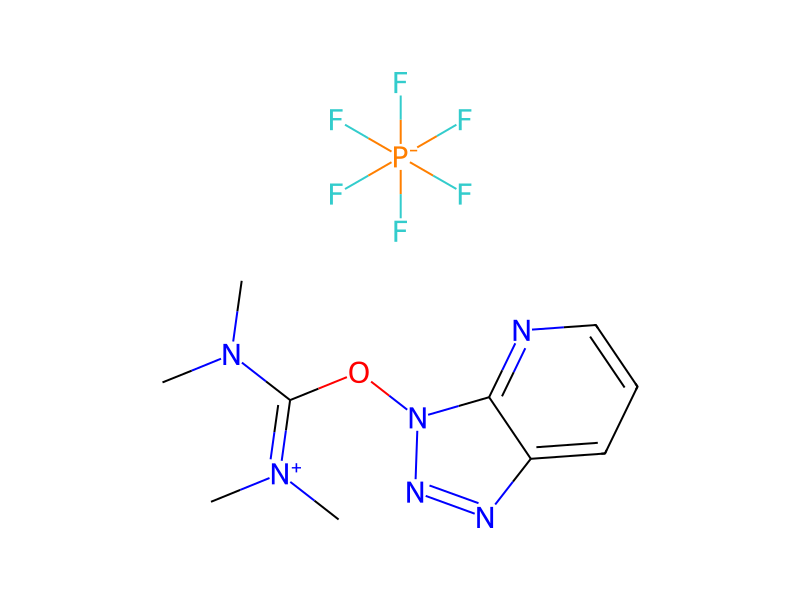 HCID 9886157Methanaminium, N-((dimethylamino)(3H-1,2,3-triazolo(4,5-b)pyridin-3-yloxy)methylene)-N-methyl-, hexafluorophosphate(1-) (1:1)
 HCID 866747552-(1,2,4-Oxadiazol-3-yl)propan-2-amine hydrochloride
 HCID 904023155-(2-(4-Fluorophenyl)-3-(methylcarbamoyl)-6-((2,2,2-trifluoroethyl)amino)furo[2,3-b]pyridin-5-yl)-2-methoxybenzoic acid
Product 1

Reagents, catalysts & solvents 1

Procedure
2-(3H-[1,2,3]triazolo[4,5-b]pyridin-3-yl)-1,1,3,3-tetramethylisouronium hexafluorophosphate(V) (22 mg, 0.058 mmol) was added to stirring solution of 5-(2-(4-fluorophenyl)-3-(methylcarbamoyl)-6-((2,2,2-trifluoroethyl)amino)furo[2,3-b]pyridin-5-yl)-2-methoxybenzoic acid (20 mg, 0.039 mmol), N-ethyl-N-isopropylpropan-2-amine (0.020 mL, 0.12 mmol) and 2-(1,2,4-oxadiazol-3-yl)propan-2-amine hydrochloride (10 mg, 0.058 mmol) in DMF (1 mL) at rt. The mixture was allowed to stir at rt for 30 min. The crude reaction mixture was then purified via preparative LC/MS with the following conditions: Column:Waters XBridge C18, 19×200 mm, 5-μm particles; Mobile Phase A: water with 20-mM ammonium acetate; Mobile Phase B: 95:5 acetonitrile:water with 20-mM ammonium acetate; Gradient: 20-100% B over 20 minutes, then a 5-minute hold at 100% B; Flow: 20 mL/min. Fractions containing the desired product were combined and dried via centrifugal evaporation. The yield of the product was 9.5 mg, and its estimated purity by LCMS analysis was 97%. Two analytical LC/MS injections were used todetermine the final purity. Injection 1 conditions: Column:Waters BEH C18, 2.0×50 mm, 1.7-μm particles; Mobile Phase A: 5:95 acetonitrile:water with 10 mM ammonium acetate; Mobile Phase B: 95:5 acetonitrile:water with 10 mM ammonium acetate; Temperature: 40° C.; Gradient: 0.5 min hold at 0% B, 0-100% B over 4 minutes, then a 0.5-minute hold at 100% B; Flow: 1 mL/min. retention time: 3.02 min; M+H: 627. Injection 2 conditions: Column:Waters BEH C18, 2.0×50 mm, 1.7-μm particles; Mobile Phase A: 5:95 methanol:water with 10 mM ammonium acetate; MobilePhase B: 95:5 methanol:water with 10 mM ammonium acetate; Temperature: 40° C.; Gradient: 0.5 min hold at 0% B, 0-100% B over 4 minutes, then a 0.5-minute hold at 100% B; Flow: 0.5 mL/min. retention time: 3.85 min; M+H: 627. Proton NMR was acquired in deuterated DMSO. 1H NMR (500 MHz, DMSO-d6) δ 9.47 (s, 1H), 8.65 (s, 1H), 8.39-8.31 (m, 1H), 7.97 (dd, J=8.9, 5.5 Hz, 2H), 7.79-7.73 (m, 1H), 7.60 (s, 1H), 7.54 (dd, J=8.5, 2.1 Hz, 1H), 7.37-7.28 (m, 3H), 6.58-6.53 (m, 1H), 4.22-4.08 (m, 2H), 4.01 (s, 3H), 2.79 (d, J=4.6 Hz, 3H), 1.73 (s, 6H).
Workup
- customThe crude reaction mixture
- customwas then purified via preparative LC/MS with the following conditions
- waitGradient: 20-100% B over 20 minutes
- customa 5-minute hold
- additionFractions containing the desired product
- customdried via centrifugal evaporation
- custom40° C.
- waitGradient: 0.5 min hold at 0% B, 0-100% B over 4 minutes
- customa 0.5-minute hold
- custom40° C.
- waitGradient: 0.5 min hold at 0% B, 0-100% B over 4 minutes
- customa 0.5-minute hold
Sources & evidence
- ORD record
- ord-edb820cbfc8047f8bbee78ead5c750d4
- Source dataset
- uspto-grants-2015_02
- Patent number
- US08962651B2
Reaction notes
Loading…