Pyridine → HCID 1522270, compound
Reaction equation

[NH:1]1[CH2:8][CH2:7][CH2:6][C@H:2]1[C:3]([OH:5])=[O:4].N1C=CC=CC=1.[O:15]([CH2:22][C:23](Cl)=[O:24])[C:16]1[CH:21]=[CH:20][CH:19]=[CH:18][CH:17]=1>O>[O:15]([CH2:22][C:23]([N:1]1[CH2:8][CH2:7][CH2:6][C@H:2]1[C:3]([OH:5])=[O:4])=[O:24])[C:16]1[CH:21]=[CH:20][CH:19]=[CH:18][CH:17]=1Participants
Reactant 3


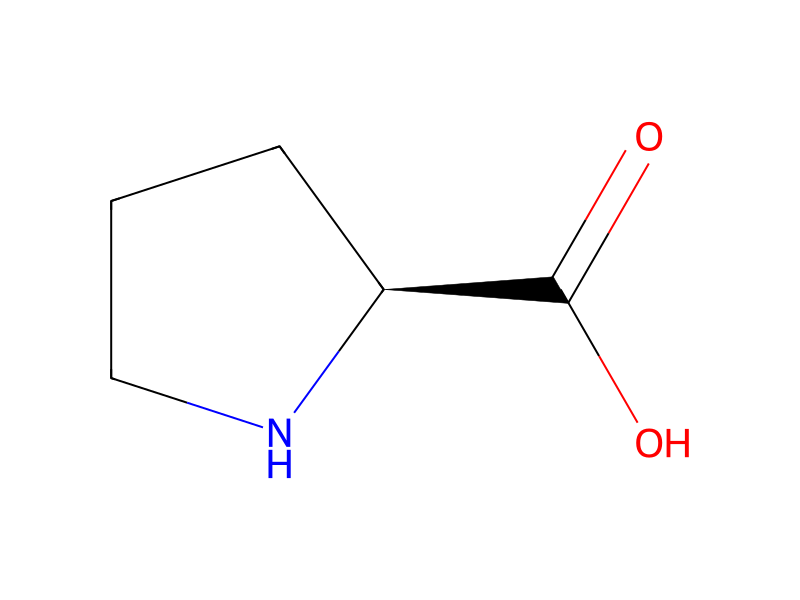
Product 1

Reagents, catalysts & solvents 1

Procedure
2.53 grams (g) of L-proline and 20 milliliters (ml) of anhydrous pyridine are mixed in a flask cooled by an ice bath, and 3.42 g of phenoxyacetyl chloride is added dropwise over about a 20-minute period. The mixture is warmed by water bath to room temperature, and the solvent evaporated under reduced pressure (in vacuo), leaving a viscuous syrup. The syrup is dissolved in 15 ml water and the water is evaporated in vacuo. The residue is dissolved in 20 ml water, and the resulting solution is filtered, and subsequently treated with 10 ml of 2 N hydrochloride. The resulting precipitate, crude phenoxyacetyl-L-proline, is purified on a chromatographic column containing 80 g of silica gel. The column is eluted with a solvent mixture composed of equal volumes of isopropanol and toluene to provide phenoxyacetyl-L-proline.
Workup
- temperaturecooled by an ice bath
- customthe solvent evaporated under reduced pressure (in vacuo)
- customleaving a viscuous syrup
- customthe water is evaporated in vacuo
- dissolutionThe residue is dissolved in 20 ml water
- filtrationthe resulting solution is filtered
- additionsubsequently treated with 10 ml of 2 N hydrochloride
- customThe resulting precipitate, crude phenoxyacetyl-L-proline, is purified on a chromatographic column
- additioncontaining 80 g of silica gel
- washThe column is eluted with a solvent mixture
Sources & evidence
- ORD record
- ord-98448a96134841d0b8305ba1a9191a09
- Source dataset
- uspto-grants-1980_08
- Patent number
- US04217269
Reaction notes
Loading…