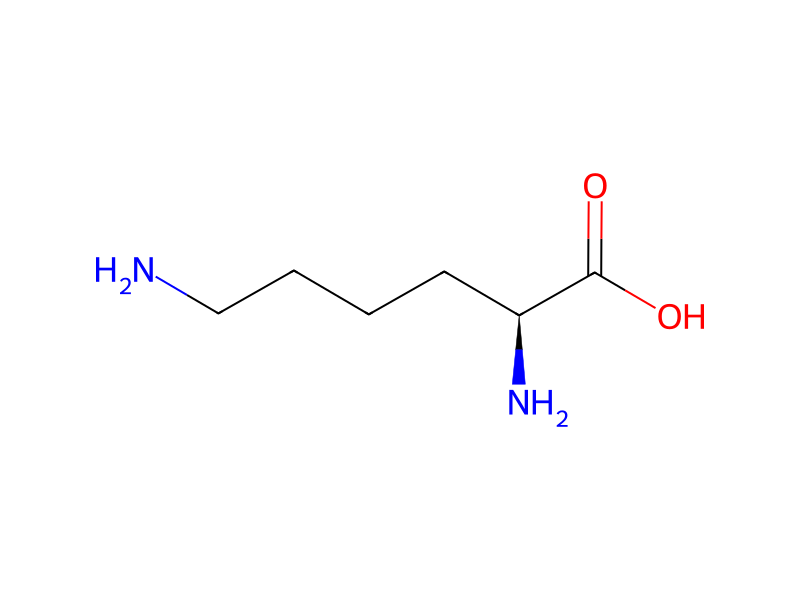
L-(+)-Cysteine → L-Lysine
Reaction equation

[NH2:1][C@H:2]([C:4]([OH:6])=[O:5])[CH3:3].N[C@H](C(O)=O)[CH2:9][SH:10].[NH2:14][C@H:15]([C:19]([OH:21])=[O:20])[CH:16](C)[CH3:17]>>[NH2:14][C@H:15]([C:19]([OH:21])=[O:20])[CH2:16][CH2:17][S:10][CH3:9].[NH2:1][C@H:2]([C:4]([OH:6])=[O:5])[CH2:3][CH2:17][CH2:16][CH2:15][NH2:14]Participants



Procedure
The present invention, in further specific embodiments, provides for (i) the construct βpα, in which the human alpha and beta globin genes are driven by separate copies of the human beta globin promoter (FIG. 1C); (ii) the εpζβpα construct, which comprises human embryonic genes zeta and epsilon under the control of the epsilon promoter and both alpha and beta genes under the control of the beta promoter (FIG. 1D); (iii) the ζpεαpβ construct, which comprises human embryonic genes zeta and epsilon under the control of the zeta promoter and both alpha and beta genes under the control of the alpha promoter (FIG. 1E); (iv) the αpβ construct carrying a mutation that results in an aspartic acid residue (rather than an asparagine residue) at amino acid number 108 of β globin protein, to produce hemoglobin Yoshizuka (FIG. 1F, construct "294"); (v) the αpβ construct carrying a mutation that results in a lysine residue (rather than an asparagine residue) at amino acid number 108 of β-globin protein, to produce hemoglobin Presbyterian (FIG. 1G, construct "293"); (vi) the αpβ(Δα) construct, coinjected with LCR α which comprises the human β-globin gene under the control of the human α-globin promoter and a separate nucleic acid fragment comprising the human α-globin gene under its own promoter (FIG. 1H); (vii) the αpβ construct carrying a mutation that results in a cysteine residue (rather than a threonine residue) at amino acid number 134 of α-globin protein (FIG. 1I); (viii) the αpβ construct carrying a mutation that results in a serine residue (rather than a cysteine residue) at amino acid number 104 of the α-globin protein, an alanine residue (rather than a cysteine residue) at amino acid number 93 of the β-globin protein and a valine residue (rather than a cysteine residue) at amino acid number 112 of the β-globin protein (FIG. 1J); (ix) the αpδ construct, which comprises the human adult α-globin promoter under its own promoter and the human δ-globin gene under the control of the human adult α-globin promoter (FIG. 1K); (x) Construct αpδ(Δα) coinjected with LCR α, which comprises the human δ-globin gene under the control of the human α-globin promoter and a separate nucleic acid fragment comprising the human α-globin gene under its own promoter (FIG. 1L); (xi) Construct LCR α coinjected with LCR εβ, which comprises the human α-globin gene under the control of its own promoter and a separate nucleic acid fragment comprising the human embryonic ε-globin gene and the adult β-globin gene under the control of their own promoters (FIG. 1M); (xii) the αpβ construct carrying a mutation that results in a methionine residue (rather than a lysine residue) at amino acid number 61 of the α-globin protein (FIG. 1N); (xiii) the εαβ construct, which comprises the human embryonic epsilon gene, the human adult alpha globin gene and the human adult beta globin gene linked in tandem from 5'- to 3' (FIG. 1O); (xiv) the αεβ construct, which comprises the human adult alpha-globin gene, the human embryonic epsilon globin gene and the human adult beta globin gene linked in tandem from 5'- to 3' (FIG. 1P); (xv) the ααεβ construct, which comprises two copies of the human adult alpha-globin gene, the human embryonic epsilon globin gene and the human adult beta globin gene linked in tandem from 5'- to 3' (FIG. 1Q); (xvi) the αε (pig βp)β construct, which comprises the human adult alpha-globin gene, the human embryonic epsilon globin gene and the human adult beta globin gene under the control of the endogenous porcine adult beta globin promoter all linked in tandem from 5'- to 3' (FIG. 1R); (xvii) the αpβ construct carrying a mutation that results in a cysteine residue (rather than an aspartic acid residue) at amino acid number 75 of the α-globin protein (FIG. 1S); (xviii) the αpβ construct carrying a mutation that results in an arginine residue (rather than a tyrosine residue) at amino acid number 42 at the α-globin protein (FIG. 1T); (xvix) the LCR εβαα construct, which comprises the human embryonic epsilon globin gene, the human adult beta globin gene and two copies of the human adult alpha-globin gene linked in tandem from 5'- to 3' (FIG. 1U); (xx) the LCR εβα construct, which comprises the human embryonic epsilon globin gene, the human adult beta globin gene and the human adult alpha-globin gene linked in tandem from 5'- to 3' (FIG. 1V); (xxi) the αpβ construct carrying a mutation that results in a lysine residue (rather than a tyrosine residue) at amino acid number 42 of the α-globin protein (FIG. 1W); (xxii) the αpβ construct carrying a mutation that results in an arginine residue (rather than a tyrosine residue) at amino acid number 42 at the α-globin protein and a glutamic acid residue (rather than an aspartic acid residue) at amino acid number 99 of the β-globin protein (FIG. 1X); (xxiii) the αpβ construct carrying a mutation that results in a lysine residue (rather than a tyrosine residue) at amino acid number 42 of the α-globin protein and a glutamic acid residue (rather than an aspartic acid residue) at amino acid number 99 of the β-globin protein (FIG. 1Y); and (xxiv) the αpig ε(pig βp)β construct comprising the pig epsilon globin gene and beta globin control region (constructs 426 and 427, FIG. 14).
Sources & evidence
- ORD record
- ord-529652045aa242d9a1201e3132ec0aac
- Source dataset
- uspto-grants-2000_11
- Patent number
- US06147202
Reaction notes
Loading…