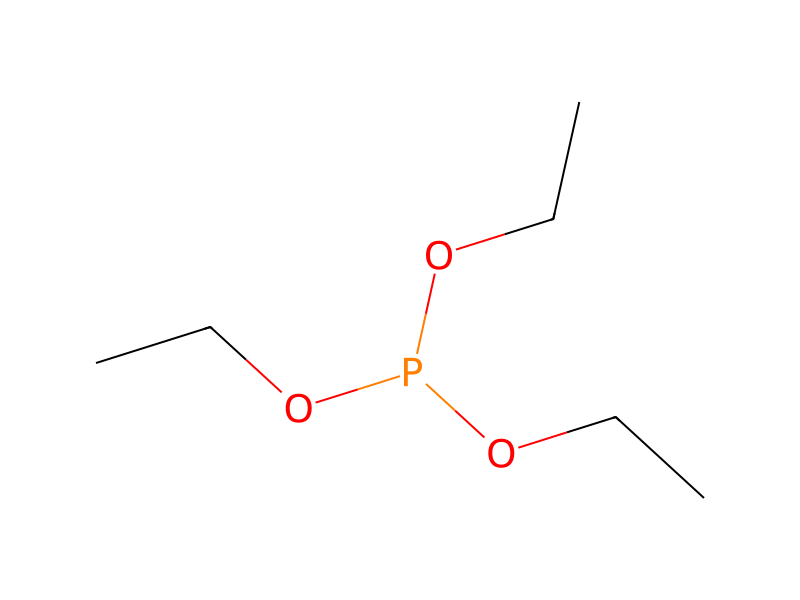
Triethyl phosphite → HCID 53666658, compound
Reaction equation

[CH3:1][O:2][C:3]1[CH:8]=[CH:7][C:6]([C:9]2[O:10][C:11]3[CH:17]=[C:16]([CH2:18]Br)[CH:15]=[CH:14][C:12]=3[N:13]=2)=[CH:5][CH:4]=1.[CH2:20]([O:22][P:23]([O:27]CC)[O:24][CH2:25][CH3:26])[CH3:21]>>[CH2:20]([O:22][P:23]([CH2:18][C:16]1[CH:15]=[CH:14][C:12]2[N:13]=[C:9]([C:6]3[CH:7]=[CH:8][C:3]([O:2][CH3:1])=[CH:4][CH:5]=3)[O:10][C:11]=2[CH:17]=1)([O:24][CH2:25][CH3:26])=[O:27])[CH3:21]Participants


Conditions
- Temperature
- 150 °C
Procedure
A round bottom flask is charged with 38 g (0.12 mole) of 2-(p-methoxyphenyl)-6-bromomethyl-benzoxazole (compound of the formula (221)) in 38 ml of triethylphosphite and the reaction mixture is heated to 150° C., kept for 30 minutes at this temperature and then excess triethylphosphite is distilled off in vacuo (10 mm). The residue, a brown oil, congeals after 10 hours. The crude product (44.5 g =98.9% of theory) is stirred with hexane in a mixer. The fine crystalline suspension is filtered by suction and the filter cake is washed with hexane, affording 40 g (88.9% of theory) of 6-(diethylphosphonomethyl)-2-(p-methoxyphenyl)-benzoxazole of the formula ##STR63## in the form of light beige-coloured crystals with a melting point of 86°-88° C.
Workup
- distillationexcess triethylphosphite is distilled off in vacuo (10 mm)
- waitThe residue, a brown oil, congeals after 10 hours
- filtrationThe fine crystalline suspension is filtered by suction
- washthe filter cake is washed with hexane
Sources & evidence
- ORD record
- ord-2f2c4edf83ab48aaa8e26251fc06a052
- Source dataset
- uspto-grants-1979_09
- Patent number
- US04167628
Reaction notes
Loading…