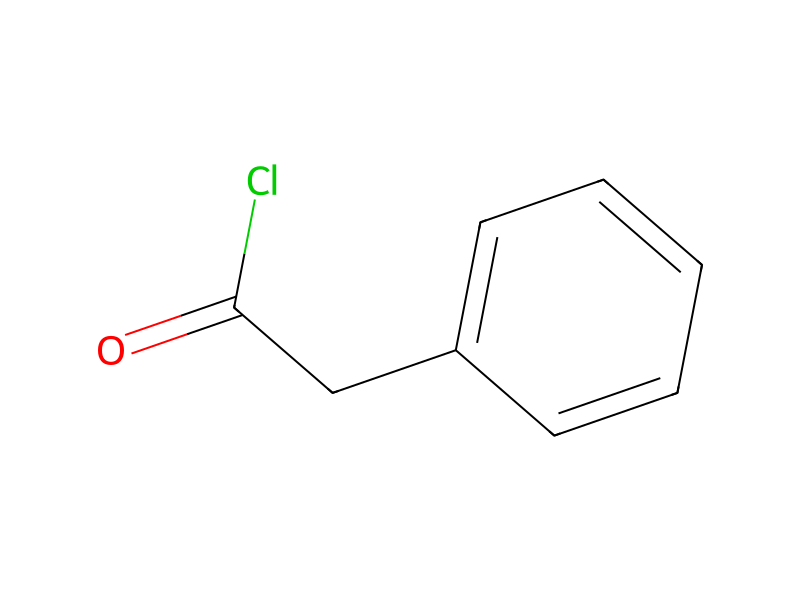
Phenylacetyl chloride → 4,9-Dihydro-4-phenylacetyl-10H-thieno[3,4-b][1,5]benzodiazepin-10-one
Reaction equation

[CH:1]1[S:2][CH:3]=[C:4]2[C:10]=1[C:9](=[O:11])[NH:8][C:7]1[CH:12]=[CH:13][CH:14]=[CH:15][C:6]=1[NH:5]2.[C:16]1([CH2:22][C:23](Cl)=[O:24])[CH:21]=[CH:20][CH:19]=[CH:18][CH:17]=1>C1C=CC=CC=1>[C:16]1([CH2:22][C:23]([N:5]2[C:6]3[CH:15]=[CH:14][CH:13]=[CH:12][C:7]=3[NH:8][C:9](=[O:11])[C:10]3=[CH:1][S:2][CH:3]=[C:4]23)=[O:24])[CH:21]=[CH:20][CH:19]=[CH:18][CH:17]=1Participants
4
Reactant 2

Product 1

Reagents, catalysts & solvents 1

Procedure
A reaction mixture comprising 6.48 g. of 4,9-dihydro-10H-thieno[3,4-b][1,5]benzodiazepin-10-one and 25 g. of phenylacetyl chloride in 100 ml. of benzene is refluxed with stirring for 3 hours. The mixture is evaporated to an amber oil, combined with 100 ml. of ethanol and 6 ml. of 5 N sodium hydroxide and allowed to stand at room temperature for one hour. This solution is evaporated to an oily residue which is triturated with water and filtered, giving the desired product as pale pink crystals, mp. 165°-168° C.
Workup
- customThe mixture is evaporated to an amber oil
- waitto stand at room temperature for one hour
- customThis solution is evaporated to an oily residue which
- customis triturated with water
- filtrationfiltered
Sources & evidence
- ORD record
- ord-bff9e9a0063c4c5f86a50e2699e56d32
- Source dataset
- uspto-grants-1979_09
- Patent number
- US04168269
Reaction notes
Loading…