Triethylamine → N-Boc-5-Bromoanthranilic acid
Reaction equation
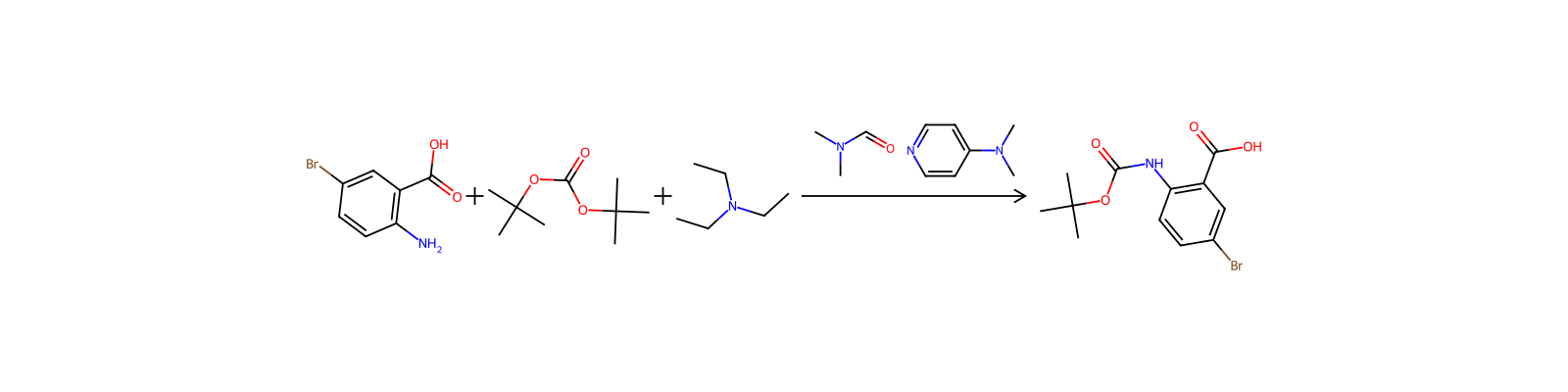
[NH2:1][C:2]1[CH:10]=[CH:9][C:8]([Br:11])=[CH:7][C:3]=1[C:4]([OH:6])=[O:5].[C:12]([O:16][C:17](=O)[O:18]C(C)(C)C)([CH3:15])([CH3:14])[CH3:13].C(N(CC)CC)C>CN(C=O)C.CN(C)C1C=CN=CC=1>[Br:11][C:8]1[CH:9]=[CH:10][C:2]([NH:1][C:17]([O:16][C:12]([CH3:15])([CH3:14])[CH3:13])=[O:18])=[C:3]([CH:7]=1)[C:4]([OH:6])=[O:5]Participants





Procedure
2-Amino-5-bromobenzoic acid (4.0 g, 0.018 mol) was dissolved in DMF (90 mL) and treated with carbonic acid di-tert-butyl ester (4.44 g, 0.020 mol), 4-dimethylaminopyridine (0.219 g, 0.0018 mol) and triethylamine (2.8 mL, 0.020 mol) for 16 h at 70° C. The mixture was concentrated in vacuo and the residue was dissolved in ethyl acetate, washed twice with saturated aqueous sodium bicarbonate, then twice with 1 N hydrochloric acid, dried over sodium sulfate. The organic layers were concentrated to afford 5-bromo-2-tert-butoxycarbonylamino-benzoic acid as a yellow solid (4.92 g, 86.7%). 1H NMR (500 MHz, DMSO-d6) δ 1.46 (s, 9H), 7.72 (dd, J=2.5, J=8.5 Hz, 1H), 8.01 (d, J=2.5 Hz, 1H), 8.22 (d, J=8.5 Hz, 1H), 10.44 (s, 1H). MS: m/z 316 (M+H+).
Workup
- concentrationThe mixture was concentrated in vacuo
- dissolutionthe residue was dissolved in ethyl acetate
- washwashed twice with saturated aqueous sodium bicarbonate
- dry with materialtwice with 1 N hydrochloric acid, dried over sodium sulfate
- concentrationThe organic layers were concentrated
Sources & evidence
- ORD record
- ord-13cd0c5fa6ef4f5cb99420729f328590
- Source dataset
- uspto-grants-2009_12
- Patent number
- US07626021B2
Reaction notes
Loading…