Sodium Carbonate → HCID 23005042, compound
Reaction equation

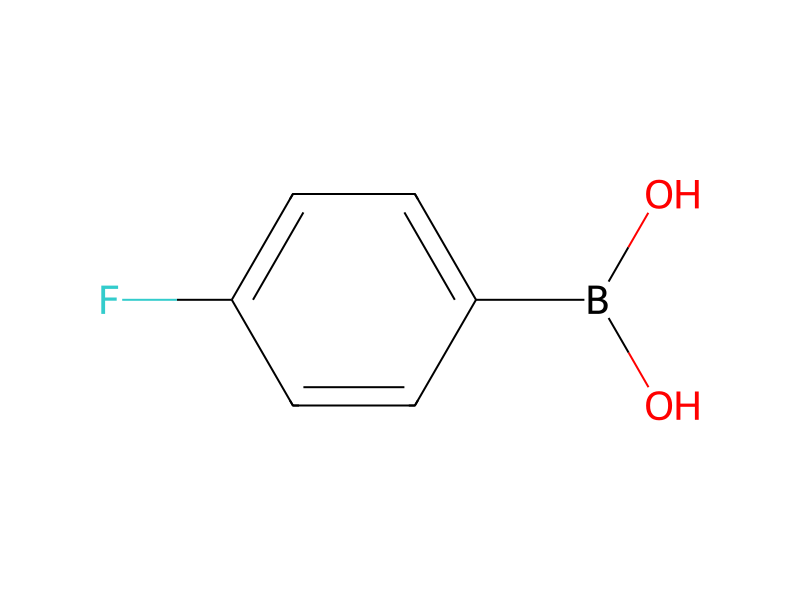
Br[C:2]1[CH:9]=[CH:8][C:5]([CH:6]=[O:7])=[C:4]([F:10])[CH:3]=1.[F:11][C:12]1[CH:17]=[CH:16][C:15](B(O)O)=[CH:14][CH:13]=1.C(=O)([O-])[O-].[Na+].[Na+]>C1(P(C2C=CC=CC=2)C2C=CC=CC=2)C=CC=CC=1.C1(P(C2C=CC=CC=2)C2C=CC=CC=2)C=CC=CC=1.C1(P(C2C=CC=CC=2)C2C=CC=CC=2)C=CC=CC=1.C1(P(C2C=CC=CC=2)C2C=CC=CC=2)C=CC=CC=1.[Pd]>[F:10][C:4]1[CH:3]=[C:2]([C:15]2[CH:16]=[CH:17][C:12]([F:11])=[CH:13][CH:14]=2)[CH:9]=[CH:8][C:5]=1[CH:6]=[O:7]Participants
5
Reactant 3


Product 1

Reagents, catalysts & solvents 1

Procedure
The method described in Example 3 (step 3.2.) is used. Starting from 5.3 g (26 mmol) of 4-bromo-2-fluorobenzaldehyde, 4 g (28.6 mmol) of 4-fluorophenylboronic acid, 26 ml (52 mmol) of aqueous sodium carbonate (2M) solution and 0.9 g (0.78 mmol) of palladium tetrakis(triphenylphosphine), 3.4 g of pure product are obtained in the form of a white solid, following chromatography on silica gel, eluting with a 10/90 mixture of ethyl acetate and cyclohexane.
Workup
- customare obtained in the form of a white solid
- washeluting with a 10/90 mixture of ethyl acetate and cyclohexane
Sources & evidence
- ORD record
- ord-b5878b318d8148a1b6400c169b1df510
- Source dataset
- uspto-grants-2009_12
- Patent number
- US07632850B2
Reaction notes
Loading…