2,4-Dichloroaniline → 5-Pyrimidinecarboxylic acid, 2-[(2,4-dichlorophenyl)amino]-4-(trifluoromethyl)-, methyl ester
Reaction equation

Cl[C:2]1[N:7]=[C:6]([C:8]([F:11])([F:10])[F:9])[C:5]([C:12]([O:14][CH3:15])=[O:13])=[CH:4][N:3]=1.[Cl:16][C:17]1[CH:23]=[C:22]([Cl:24])[CH:21]=[CH:20][C:18]=1[NH2:19]>O1CCOCC1>[Cl:16][C:17]1[CH:23]=[C:22]([Cl:24])[CH:21]=[CH:20][C:18]=1[NH:19][C:2]1[N:7]=[C:6]([C:8]([F:11])([F:10])[F:9])[C:5]([C:12]([O:14][CH3:15])=[O:13])=[CH:4][N:3]=1Participants
4

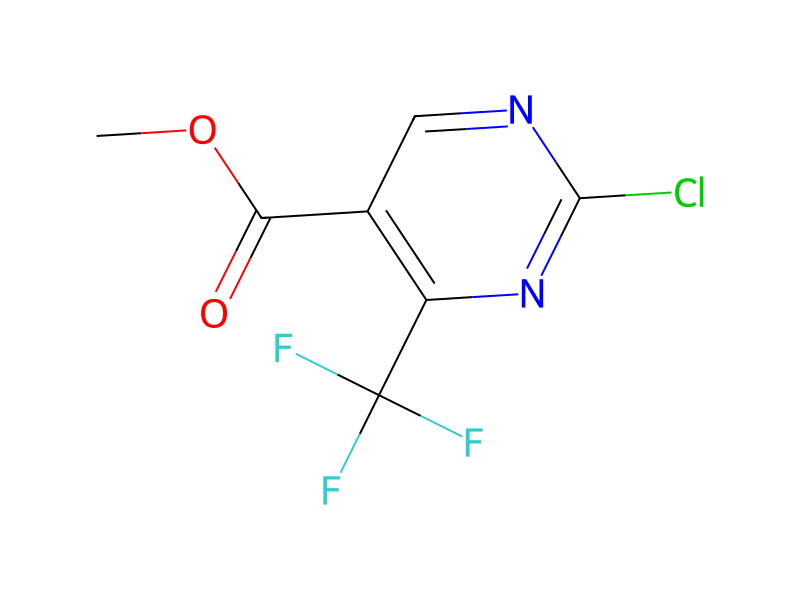


Procedure
To a solution of methyl 2-chloro-4-trifluoromethyl-pyrimidine-5-carboxylate (0.50 g, ex Maybridge) in 1,4-dioxan (5 ml) was added 2,4-dichloroaniline (1.7 g) and the solution stirred under reflux for 7 h. 1,4-Dioxan was removed under reduced pressure and ethyl acetate (15 ml) added. The solution was washed sequentially with 2N hydrochloric acid (10 ml) and water (3×10 ml), dried (MgSO4), evaporated and triturated with hexane to afford methyl 2-(2,4-dichlorophenylamino)-4-trifluoromethylpyrimidine-5-carboxylate (358 mg).
Workup
- temperatureunder reflux for 7 h
- custom1,4-Dioxan was removed under reduced pressure and ethyl acetate (15 ml)
- additionadded
- washThe solution was washed sequentially with 2N hydrochloric acid (10 ml) and water (3×10 ml)
- dry with materialdried (MgSO4)
- customevaporated
- customtriturated with hexane
Sources & evidence
- ORD record
- ord-39353f5692cc4f778b9d319d99244bd9
- Source dataset
- uspto-grants-2009_12
- Patent number
- US07635701B2
Reaction notes
Loading…