N-Methylmorpholine N-oxide monohydrate → 4-(Cyclohexylamino)-3-nitrobenzaldehyde
Reaktionsgleichung

[CH:1]1([NH:7][C:8]2[CH:15]=[CH:14][C:11]([CH2:12][OH:13])=[CH:10][C:9]=2[N+:16]([O-:18])=[O:17])[CH2:6][CH2:5][CH2:4][CH2:3][CH2:2]1.O.C[N+]1([O-])CCOCC1>C(Cl)Cl.[Ru]([O-])(=O)(=O)=O.C([N+](CCC)(CCC)CCC)CC>[CH:1]1([NH:7][C:8]2[CH:15]=[CH:14][C:11]([CH:12]=[O:13])=[CH:10][C:9]=2[N+:16]([O-:18])=[O:17])[CH2:2][CH2:3][CH2:4][CH2:5][CH2:6]1Komponenten
Edukt 2


Produkt 1

Reagenzien, Katalysatoren, Lösungsmittel 2

Versuchsvorschrift
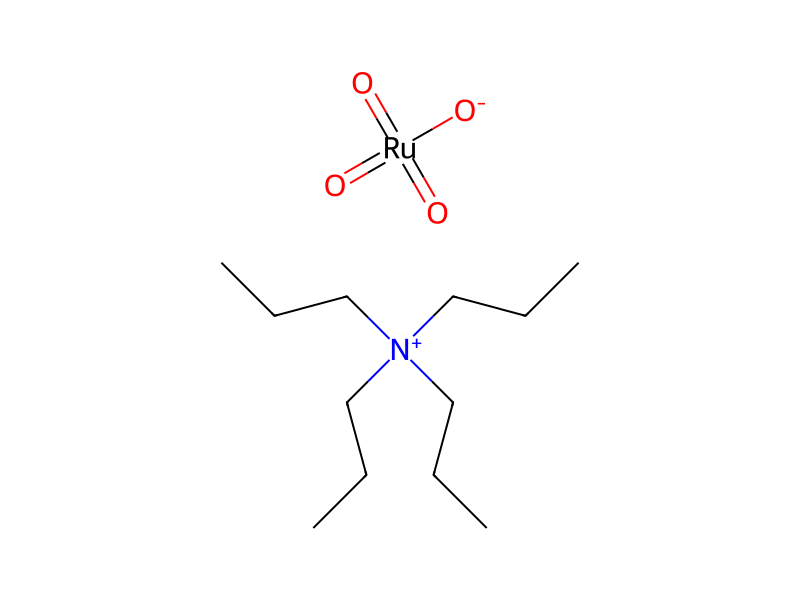
To a solution of 4-cyclohexylamino-3-nitrobenzyl alcohol (21.0 g, 83 mmol) in DCM (300 mL) was added powdered 4A molecular sieves (15 g) and N-methyl morpholine-N-oxide monohydrate (10.8 g, 92.2 mmol). Tetra-n-propylammonium perruthenate (VII) (2.91 g, 8.28 mmol) was then added in a single portion. An initial exotherm was controlled using an ice bath, and then the reaction mixture was stirred at room temperature for 18 hr. The mixture was then reduced to ˜100 mL by evaporation, and loaded onto a column of silica (400 g). The column was eluted with acetone:hexane 1:3 and the spot at 0.30 was collected, affording 4-cyclohexylamino-3-nitrobenzaldehyde as a yellow solid. (11.0 g, 44.3 mmol): 1H NMR (CDCl3, 300 MHz) δ 9.60 (s, 1H), 8.32 (s, 1H), 7.71 (d, J=10 Hz, 1H), 6.73 (d, J=10 Hz, 1H) 3.46-3.32 (m, 1H), 1.90-1.15 (m, 10H).
Aufarbeitung
- customThe mixture was then reduced to ˜100 mL by evaporation
- washThe column was eluted with acetone:hexane 1:3
- customthe spot at 0.30 was collected
Quellen und Nachweise
- ORD-Eintrag
- ord-bc3e2f82d27e4142acf50b4819874f02
- Quelldatensatz
- uspto-grants-2009_12
- Patentnummer
- US07635774B2
Notizen zur Reaktion
Wird geladen…