9-Octadecenoic Acid → 10-Nitrolinoleic acid
Reaction equation

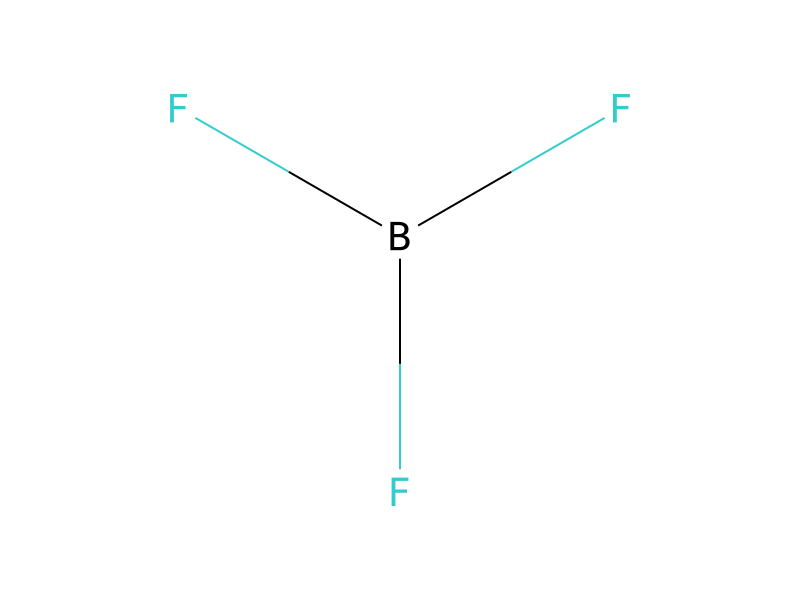
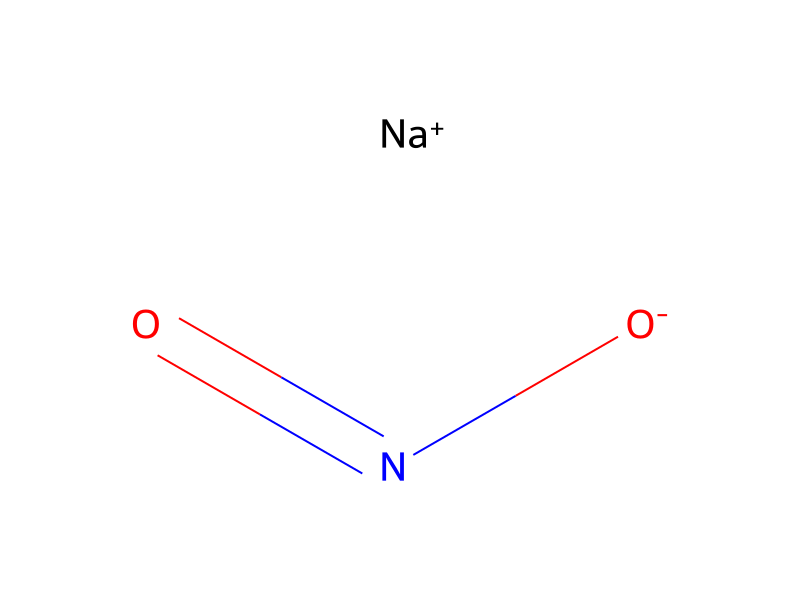
[C:1]([OH:20])(=[O:19])[CH2:2][CH2:3][CH2:4][CH2:5][CH2:6][CH2:7][CH2:8][CH:9]=[CH:10][CH2:11][CH2:12][CH2:13][CH2:14][CH2:15][CH2:16][CH2:17][CH3:18].COC(=O)CCCCCCCC=CCCCCCCCC.C1([Se]Br)C=CC=CC=1.[N:50]([O-:52])=[O:51].[Na+].C[C@H]1[C@](O)(C(CO)=O)[C@]2(C)[C@H]([C@H]3[C@](F)([C@@H](O)C2)[C@]2(C)C(=CC(C=C2)=O)CC3)C1.C(N1C2N=CNC=2C(=O)N(C)C1=O)C(C)C.B(F)(F)F.C(O)(=O)CCCCCCC/C=C\CCCCCCCC.N1(C(=O)C2N(C)C=NC=2N(C)C1=O)C>O1CCCC1.C(#N)C.CO.Cl[Hg]Cl.CCCCCC.CCOCC.C(O)(=O)C.CC#N.O1CCCC1>[CH3:18][CH2:17][CH2:16][CH2:15][CH2:14]/[CH:13]=[CH:12]\[CH2:11]/[C:10](/[N+:50]([O-:52])=[O:51])=[CH:9]\[CH2:8][CH2:7][CH2:6][CH2:5][CH2:4][CH2:3][CH2:2][C:1]([OH:20])=[O:19]Participants
Reactant 9




Product 1

Reagents, catalysts & solvents 6



Conditions
- Temperature
- 25 °C
Procedure
Materials. 9-Octadecenoic acid (oleic acid) and its respective methyl ester, methyl-9-octadecenoate was purchased from Nu-Check Prep (Elysian, Minn.). LNO2 and [13C]LNO2 were synthesized as previously described (9,12); OA-NO2 and [13C]OA-NO2 were synthesized as described in below. Phenylselenium bromide, HgCl2, NaNO2, anhydrous tetrahydrofuran (THF), CH3CN, CDCl3, insulin, dexamethasone and 3-isobutyl-1-methylxanthine were obtained from Sigma/Aldrich (St Louis, Mo.). Silica gel G and HF thin layer chromatography plates (250 and 2000 μm) were from Analtech (Newark, Del.). Methanolic BF3, horseradish peroxidase-linked goat anti-rabbit IgG and Coomasie Blue were from Pierce (Rockford, Ill.). Synthetic solvents were of HPLC grade or better from Fisher Scientific (Fairlawn, N.J.). Solvents used for extractions and mass spectrometric analyses were from Burdick and Jackson (Muskegon, Mich.). [13C]Oleic acid and [13C]linoleic acid were purchased from Cambridge Isotope Laboratories, Inc. (Andover, Mass.). Anti-PPARγ and anti-β-actin antibodies were from Santa Cruz (Santa Cruz, Calif.); anti-aP2 antibody was from Chemicon International Inc. (Temecula, Calif.). Synthesis of OA-NO2. Oleic acid and [13C]oleic acid were nitrated as described (9,12), with modifications. Briefly, oleic acid, HgCl2, phenylselenium bromide and NaNO2 (1:1.3:1:1, mol/mol) were combined in THF/acetonitrile (1:1, v/v) with a final concentration of 0.15 M oleic acid. The reaction mixture was stirred (4 h, 25° C.), followed by centrifugation to sediment the precipitate. The supernatant was recovered, the solvent evaporated in vacuo, the product mixture redissolved in THF (original volume) and the temperature reduced to 0° C. A ten-fold molar excess of H2O2 was slowly added with stirring to the mixture, which was allowed to react in an ice bath for 20 min followed by a gradual warming to room temp (45 min). The product mixture was extracted with hexane, the organic phase collected, the solvent removed in vacuo and lipid products solvated in CH3OH. OA-NO2 was isolated by preparative TLC using silica gel HF plates developed twice in a solvent system consisting of hexane/ether/acetic acid (70:30:1, v/v). The region of silica containing OA-NO2 was scraped and extracted (21). Based on this synthetic rationale, two regioisomers are generated: 9- and 10-nitro-9-cis-octadecenoic acids (generically termed OA-NO2). Thin layer chromatography does not resolve the two isomers. [13C]OA-NO2 was synthesized using [13C]oleic acid as a reactant. Stock concentrations of OA-NO2 isomers were quantitated by chemiluminescent nitrogen analysis (Antek Instruments, Houston, Tex.), using caffeine as a standard. All standards were diluted in methanol, aliquoted and stored under argon gas at −80° C. Under these conditions, OA-NO2 isomers remain stable for >3 months. OA-NO2 spectrophotometric characterization. OA-NO2 stock solution concentrations were initially determined by chemiluminescent nitrogen analysis. These data were utilized to determine dilution concentrations for subsequent spectral analysis. An absorbance spectrum of OA-NO2 from 200-450 nm was generated using 23 μM OA-NO2 in phosphate buffer (100 mM, pH 7.4) containing 100 μM DTPA. The extinction coefficients (ε) for OA-NO2 and the isotopic derivative [13C]OA-NO2 were measured (λ270) using a UV-VIS spectrophotometer (Shimadzu, Japan). Absorbance values for increasing concentrations of OA-NO2 and [13C]OA-NO2 were plotted against concentration to calculate ε. NMR spectrometric analysis of OA-NO2—1H and 13C NMR spectra were measured using a Varian INOVA 300 and 500 MHz NMR and recorded in CDCl3. Chemical shifts are in δ units (ppm) and referenced to residual proton (7.26 ppm) or carbon (77.28 ppm) signals in deuterated chloroform. Coupling constants (J) are reported in Hertz (Hz). Gas chromatography mass spectrometric characterization of OA-NO2. Methyl esters of purified synthetic OA-NO2 regioisomers were analyzed by electron impact ionization gas chromatography mass spectrometry (EI GC-MS). Fatty acid methyl esters of OA-NO2 were synthesized, extracted with hexane, washed twice with saturated saline, redissolved in undecane and analyzed by GC-MS using a Saturn 2000 Tandem Mass Spectrometer coupled to a Varian 3800 Gas Chromatograph.
Workup
- customOA-NO2 and [13C]OA-NO2 were synthesized
- extractionSolvents used for extractions and mass spectrometric analyses
- customSynthesis of OA-NO2
- customThe supernatant was recovered
- customthe solvent evaporated in vacuo
- dissolutionthe product mixture redissolved in THF (original volume)
- customreduced to 0° C
- additionA ten-fold molar excess of H2O2 was slowly added
- stirringwith stirring to the mixture, which
- customto react in an ice bath for 20 min
- temperaturea gradual warming to room temp (45 min)
- extractionThe product mixture was extracted with hexane
- customthe organic phase collected
- customthe solvent removed in vacuo and lipid products
- customOA-NO2 was isolated by preparative TLC
- extractionextracted (21)
- custom[13C]OA-NO2 was synthesized
- customstored under argon gas at −80° C
- waitUnder these conditions, OA-NO2 isomers remain stable for >3 months
- concentrationOA-NO2 stock solution concentrations
- concentrationdilution concentrations for subsequent spectral analysis
- additioncontaining 100 μM DTPA
- temperatureAbsorbance values for increasing concentrations of OA-NO2 and [13C]OA-NO2
- concentrationwere plotted against concentration
- extractionextracted with hexane
- washwashed twice with saturated saline
- dissolutionredissolved in undecane
Sources & evidence
- ORD record
- ord-f202a8d137f4498ca708c93566587b4e
- Source dataset
- uspto-grants-2012_11
- Patent number
- US08309526B2
Reaction notes
Loading…