Sodium hydride → Ethyl 2-(5-bromo-2-oxopyridin-1(2H)-yl)propanoate
Reaction equation

[Br:1][C:2]1[CH:3]=[CH:4][C:5](=[O:8])[NH:6][CH:7]=1.[H-].[Na+].Br[CH:12]([CH3:18])[C:13]([O:15][CH2:16][CH3:17])=[O:14]>CN(C=O)C>[Br:1][C:2]1[CH:3]=[CH:4][C:5](=[O:8])[N:6]([CH:12]([CH3:18])[C:13]([O:15][CH2:16][CH3:17])=[O:14])[CH:7]=1Participants
Reactant 3


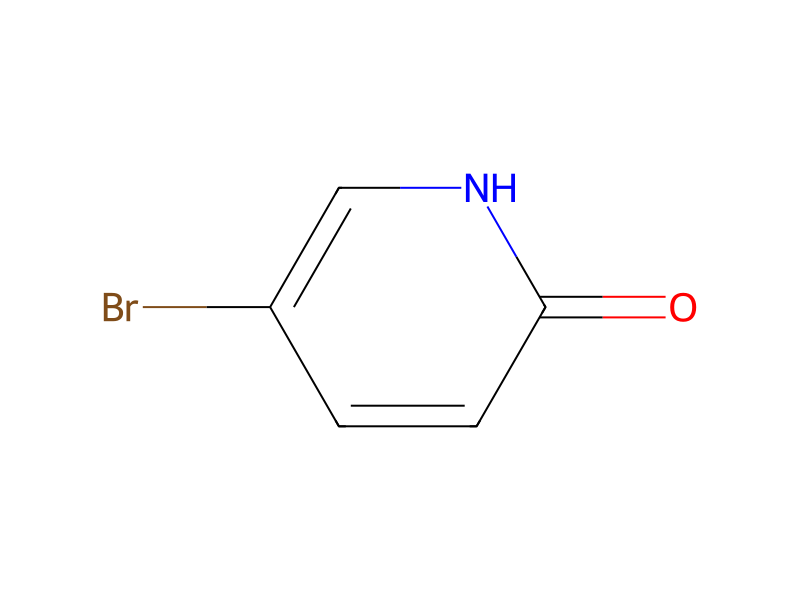
Product 1

Reagents, catalysts & solvents 1

Conditions
- Temperature
- 0 °C
Procedure
To a solution of 5-bromo-2(1H)-pyridone (7.8 g, 45 mmol) in 80 mL of DMF at 0° C. was added sodium hydride (60% dispersion in mineral oil, 2.1 g, 90 mmol). The mixture was stirred at 0° C. for 45 minutes. Ethyl 2-bromopropionate (9.7 g, 54 mmol) was then added via a syringe. The reaction was warmed up to rt and let stir for 16 hours. The reaction mixture was then poured into an ice-HCl (2N) solution until pH˜2. The aqueous mixture was extracted with 2×100 mL of EtOAc. The combined organic phases were dried over Na2SO4 and concentrated in vacuo. The residue was chromatographed on a silica gel column (30% EtOAc/hexane to EtOAC) to give yellow oil (9.0 g, 73% yield) as desired product. MS (ESI pos. ion) m/z (MH+): 273.9. Calc'd Exact Mass for C10H12BrNO3: 273.00.
Workup
- temperatureThe reaction was warmed up to rt
- stirringlet stir for 16 hours
- extractionThe aqueous mixture was extracted with 2×100 mL of EtOAc
- dry with materialThe combined organic phases were dried over Na2SO4
- concentrationconcentrated in vacuo
- customThe residue was chromatographed on a silica gel column (30% EtOAc/hexane to EtOAC)
Sources & evidence
- ORD record
- ord-b0ddca0713ad4b91bd9c53627d016f61
- Source dataset
- uspto-grants-2012_11
- Patent number
- US08314087B2
Reaction notes
Loading…