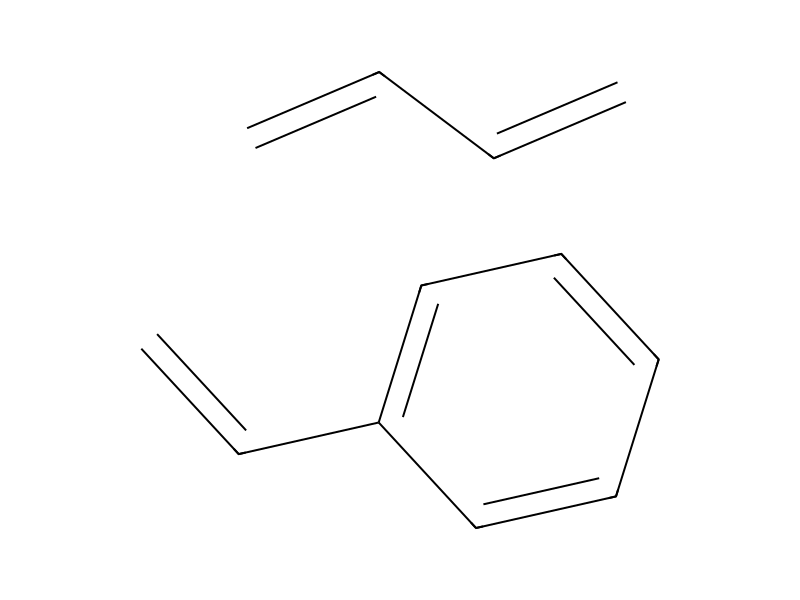
Water → Benzene, ethenyl-, polymer with 1,3-butadiene
Reaction equation

[CH2:1]=[CH:2][C:3]1[CH:8]=[CH:7][CH:6]=[CH:5][CH:4]=1.C=CC=C.C([Li])CCC.O>CCCCCC>[CH2:1]=[CH:2][CH:3]=[CH2:4].[CH2:1]=[CH:2][C:3]1[CH:8]=[CH:7][CH:6]=[CH:5][CH:4]=1Participants
Reactant 4




Product 1
Reagents, catalysts & solvents 1

Procedure
To a 5-gallon reactor equipped with turbine agitator blades was added 5320 g of hexane, 1320 g of 33.0 wt % styrene in hexane, and 7776 g of 22.4 wt % 1,3-butadiene in hexane. To the reactor was charged 11.34 mL of 1.6 M n-butyllithium in hexane and 3.74 mL of 1.6 M 2,2-bis(2′-tetrahydrofuryl)propane in hexane. The batch was heated by applying hot water to the reactor jacket. Once the batch temperature reached 50° C., the reactor jacket was cooled with cold water. Ninety minutes after the addition of the catalyst, 402 g of the resulting living polymer cement was transferred from the reactor into a nitrogen-purged bottle, quenched by addition of 3 mL of isopropanol containing 0.3 g of 2,6-di-tert-butyl-4-methylphenol, coagulated with 3 liters of isopropanol containing 0.5 g of 2,6-di-tert-butyl-4-methylphenol, and then drum-dried. The Mooney viscosity (ML1+4) of the resulting polymer was determined to be 11.5 at 100° C. by using a Monsanto Mooney viscometer with a large rotor, a one-minute warm-up time, and a four-minute running time. As determined by gel permeation chromatography (GPC), the polymer had a number average molecular weight (Mn) of 120,300 g/mole, a weight average molecular weight (Mw) of 125,200 g/mole, and a molecular weight distribution (Mw/Mn) of 1.04. The 1H NMR analysis of the polymer indicated that the polymer had a styrene content of 19.7 wt % and a 1,2-linkage (butadiene unit) of 57.4%. As measured by differential scanning calorimetry (DSC), the polymer had a glass transition temperature (Tg) of −32° C. The properties of the resulting unmodified SBR are summarized in Table 4.
Workup
- customTo a 5-gallon reactor equipped with turbine agitator blades
- temperatureThe batch was heated
- customreached 50° C.
- additionNinety minutes after the addition of the catalyst, 402 g of the resulting living polymer cement
- custompurged bottle
- customquenched by addition of 3 mL of isopropanol containing 0.3 g of 2,6-di-tert-butyl-4-methylphenol
- customdrum-dried
- customat 100° C.
- temperaturea one-minute warm-up time
- customa glass transition temperature (Tg) of −32° C
Sources & evidence
- ORD record
- ord-22fd3804b6024b93afcfa8e7e5a52af4
- Source dataset
- uspto-grants-2012_11
- Patent number
- US08314189B2
Reaction notes
Loading…