4-Hydroxybenzophenone → HCID 59487983, compound
Reaction equation

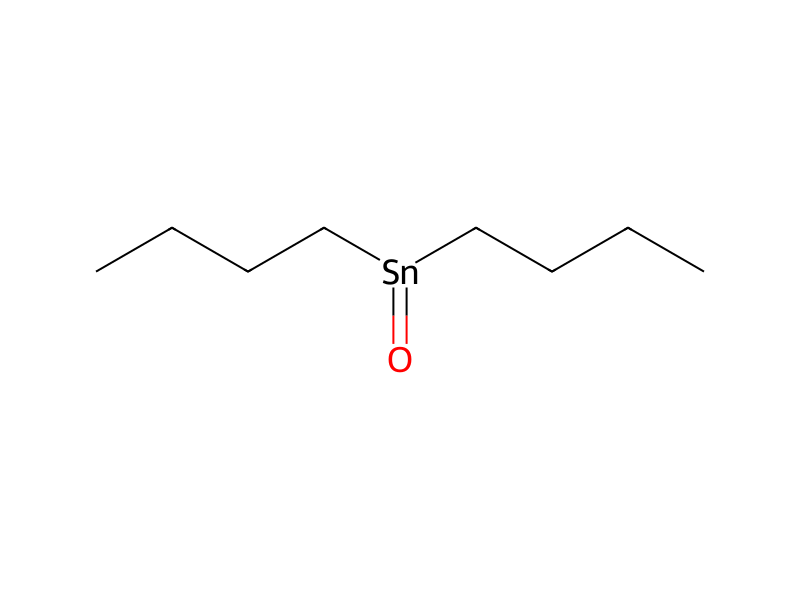
[OH:1][C:2]1[CH:15]=[CH:14][C:5]([C:6]([C:8]2[CH:13]=[CH:12][CH:11]=[CH:10][CH:9]=2)=[O:7])=[CH:4][CH:3]=1.[CH2:16]([Sn:20](=[O:25])[CH2:21][CH2:22][CH2:23][CH3:24])[CH2:17][CH2:18][CH3:19]>>[O:25]([Sn:20]([CH2:21][CH2:22][CH2:23][CH3:24])([CH2:16][CH2:17][CH2:18][CH3:19])[O:1][C:2]1[CH:15]=[CH:14][C:5]([C:6](=[O:7])[C:8]2[CH:13]=[CH:12][CH:11]=[CH:10][CH:9]=2)=[CH:4][CH:3]=1)[Sn:20]([CH2:21][CH2:22][CH2:23][CH3:24])([CH2:16][CH2:17][CH2:18][CH3:19])[O:1][C:2]1[CH:3]=[CH:4][C:5]([C:6](=[O:7])[C:8]2[CH:13]=[CH:12][CH:11]=[CH:10][CH:9]=2)=[CH:14][CH:15]=1Participants
3


Conditions
- Temperature
- 150 °C
Procedure
In a bulb-to-bulb distillation apparatus (“Kugelrohr”) 3 g (15.1 mmol) of 4-hydroxy-benzophenone and 1.9 g (7.6 mmol) of dibutyltin oxide are slowly heated to 150° C. in high vacuum (0.009 mbar). The mixture begins to melt and at 200° C. the distillation starts and is finished after about 10 minutes. After cooling the colorless distillate is identified as 4-hydroxy-benzophenone by 1H-NMR spectrum. The residue (about 3.3 g) is crystallized several times from hot toluene. 2.0 g of the title product are obtained as white crystals melting at 150-159° C. The structure is further confirmed by 1H-NMR and 13C-NMR spectra.
Workup
- customto melt and at 200° C.
- distillationthe distillation starts
- temperatureAfter cooling the colorless distillate
- customThe residue (about 3.3 g) is crystallized several times from hot toluene
Sources & evidence
- ORD record
- ord-91b797dea0da46d0b4b1fefde9f87afa
- Source dataset
- uspto-grants-2012_11
- Patent number
- US08318830B2
Reaction notes
Loading…