Aniline → 7-Bromodiethylfluorene-2-aldehyde
Reaction equation
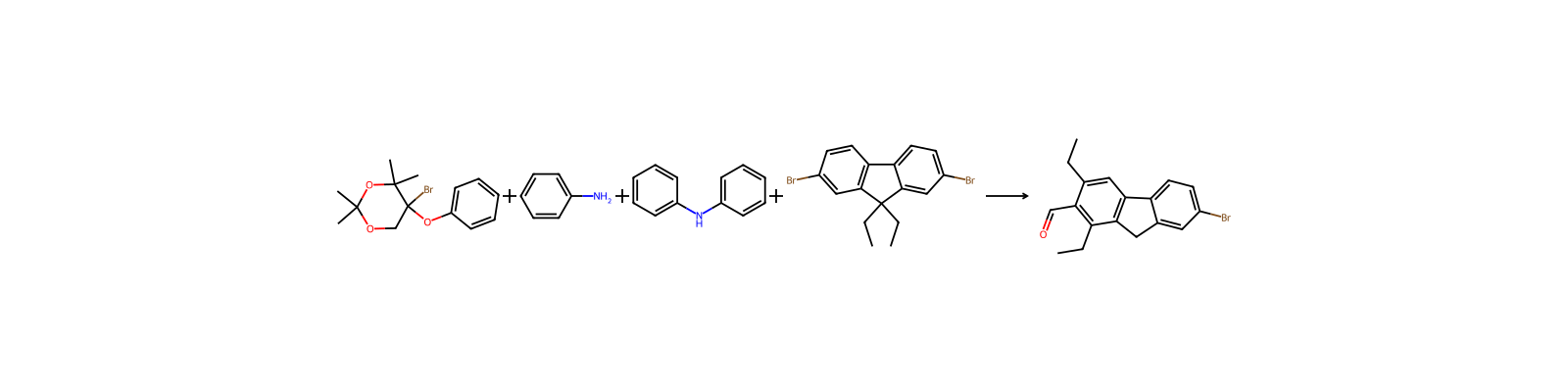
BrC1([O:12][C:13]2C=[CH:17][CH:16]=[CH:15][CH:14]=2)COC(C)(C)OC1(C)C.NC1C=CC=CC=1.C1(NC2C=CC=CC=2)C=CC=CC=1.[Br:39][C:40]1[CH:52]=[CH:51][C:50]2[C:49]3[C:44](=[CH:45][C:46](Br)=[CH:47][CH:48]=3)[C:43](CC)(CC)[C:42]=2[CH:41]=1>>[Br:39][C:40]1[CH:41]=[C:42]2[C:50]([C:49]3[CH:48]=[C:47]([CH2:46][CH3:45])[C:14]([CH:13]=[O:12])=[C:15]([CH2:16][CH3:17])[C:44]=3[CH2:43]2)=[CH:51][CH:52]=1Participants



Procedure
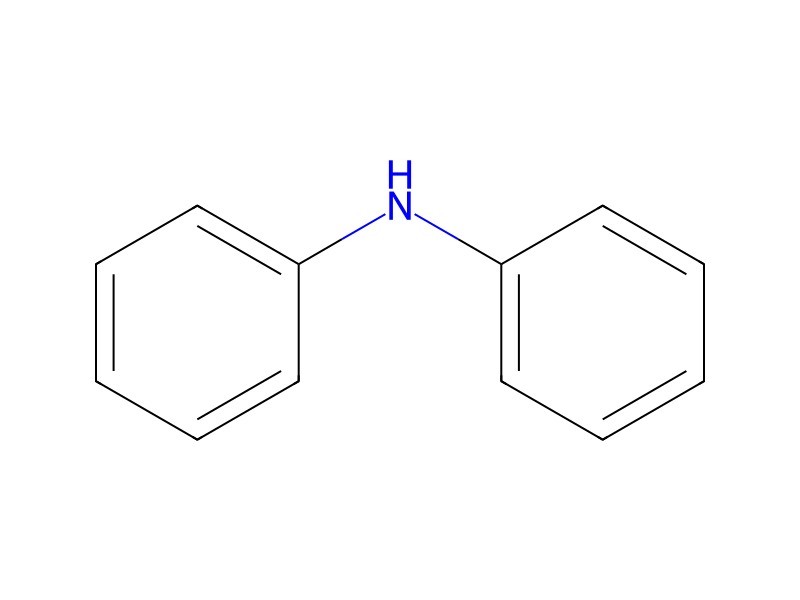
The convergent synthesis of AF-452-6OH (compound 9 in Scheme 1) was accomplished in two parallel sequences followed by a converging sequence: (i) a 4-step sequence to the protected 3-O-alkylated diphenylamine intermediate, (ii) a 3-step sequence to the tris(7-bromofluorene(triazine intermediate 7 and (ii) a 2-step sequence to AF-452-6OH (8). Briefly, the first sequence was started with tris-1,1,1-(hydroxymethyl)ethane, which was first protected as an acetonide derivative, i.e. 2,2,5-trimethyl-5-hydroxymethyl-1,3-dioxane (compound 1) in either reaction as indicated in Scheme 1, as reactions (i) or (ii). A Mitsunobu reaction of 1 with 3-bromophenol furnished the corresponding bromophenoxy-methyltrimethyl-1,3-dioxane (2) in 85% yield [Scheme 1, reaction (iii)]. The same compound could also be obtained in 59% yield from a copper-catalyzed reaction between 3-bromoiodobenzene and 1 [Scheme 1, reaction (iv)]. Compound 2 was aminated with aniline to produce the diphenylamine intermediate 3 [Scheme 1, reaction (v)]. In the second sequence, 2,7-dibromo-9,9-diethylfluorene (4) was first monoformylated to form 7-bromodiethylfluorene-2-aldehyde (5), which was then converted to the nitrile intermediate (6) in 93% yield [Scheme 1, reactions (vi) and (viii), respectively]. A less satisfactory conversion of the aldehyde intermediate 5 to the nitrile intermediate 6 via an hydroxyl-imine intermediate was also conducted [49% yield, Scheme 1, reaction (vii)]. The nitrile intermediate 6 was subsequently and catalytically trimerized in trifluoromethanesulfonic acid to afford the tribromo-1,3,5-triazine intermediate (7) in 95% yield [Scheme 1, reaction (ix)]. Covalently joining the triazine (7) component with the diphenylamine component (3) with the assistance of a Pd-catalyzed amination gave the precursor chromophore protected as an acetonide 8, [Scheme 1, reaction (x)]. Removal of the acetone protecting groups from 8 was accomplished by mixing and stirring 8 together with Dowex-50Wx2 (acid-form) resin, and the desired product, AF-452-6OH (9), was obtained in 90% yield [Scheme 1, reaction (xi)].
Workup
- customto produce
Sources & evidence
- ORD record
- ord-5ca21cce9821470bb6aea0a5f2813d1d
- Source dataset
- uspto-grants-2012_11
- Patent number
- US08318888B1
Reaction notes
Loading…