Ethylene Oxide → Tris(2-chloroethyl) phosphate
Reaction equation

[P:1]([O:10][CH2:11][CH2:12][Cl:13])([O:6][CH2:7][CH2:8][Cl:9])[O:2][CH2:3][CH2:4][Cl:5].C1[O:16]C1>>[P:1]([O:10][CH2:11][CH2:12][Cl:13])([O:6][CH2:7][CH2:8][Cl:9])([O:2][CH2:3][CH2:4][Cl:5])=[O:16]Participants
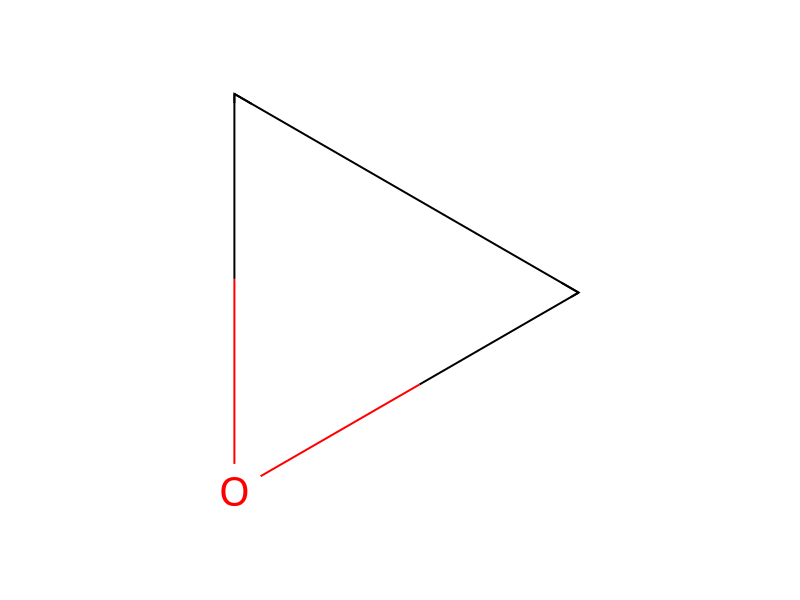


Procedure
However, phosphorus trichloride can easily be oxidized by oxygen or oxygen-containing gases to phosphorus oxychloride. A slow, steady increase in the phosphorus oxychloride content can be observed during storage, transport and use of phosphorus trichloride. The phosphorus oxychloride lowers the quality of the phosphorus trichloride and necessarily leads to undesirable by-products during chemical processing, so that the desired end product is of lower quality and is obtained in a lesser yield. For example, in further processing to phosphorus pentachloride or phosphorus sulfochloride, all the phosphorus oxychloride reaches the end product. Because of the physical properties, subsequent separation is much more difficult than separation from phosphorus trichloride. During further processing to phosphorous acid, phosphoric acid is formed from the phosphorus oxychloride and phosphates are formed as by-products during the reaction with alcohols to phosphites. During the synthesis of tri-(2-chloroethyl) phosphite by reaction with ethylene oxide, tri-(2-chloroethyl) phosphate is formed as an interfering by-product.
Sources & evidence
- ORD record
- ord-189ec30f95b3427198fac53cfb71aaab
- Source dataset
- uspto-grants-1992_09
- Patent number
- US05147622
Reaction notes
Loading…