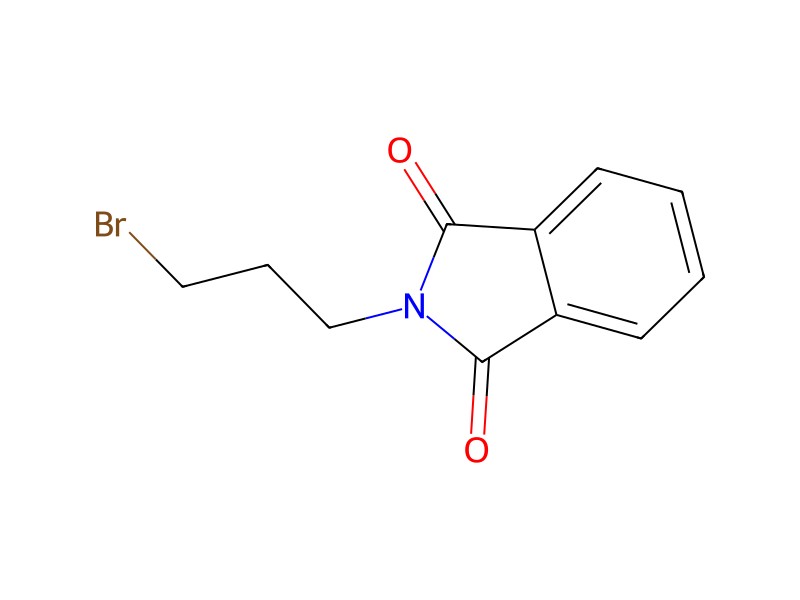
N-3-Bromopropylphthalimide → Diethyl (3-aminopropyl)phosphonate
Reaction equation

BrCCC[N:5]1[C:9](=O)[C:8]2=[CH:11]C=CC=C2C1=O.[P:16]([O:23]CC)([O:20][CH2:21][CH3:22])[O:17][CH2:18][CH3:19]>>[NH2:5][CH2:9][CH2:8][CH2:11][P:16](=[O:23])([O:20][CH2:21][CH3:22])[O:17][CH2:18][CH3:19]Participants


Conditions
- Temperature
- 140 °C
Procedure
70 ml of triethyl phosphite was added to 40 g of N-(3-bromopropyl)phthalimide (7). The mixture was heated to a temperature of 140° C. The by-produced ethyl bromide was distilled off. The system was then heated over 4 hours. Excess triethyl phosphite was distilled off under reduced pressure by an aspirator. 9 ml of ethanol and hydrazine hydrate were added to the concentrated solution. The system was heated under reflux over 20 minutes. The resulting crystals were filtered off. A mixture of 10 g of oxalic acid and 50 ml of acetone were added to the filtrate. The resulting crystals were filtered off. The filtrate was concentrated. A small amount of water and acetone were added to the residue. The resulting crystals were filtered off. The filtrate was cooled to deposit crystals of oxalic acid salt of diethyl 3-aminopropylphosphonate (8). The crystals were filtered and dried under reduced pressure by a vacuum pump to obtain 12 g of diethyl 3-aminopropylphosphonate (8) in the form of oxalate. (Yield: 34 %; m.p. 54° C.)
Workup
- distillationThe by-produced ethyl bromide was distilled off
- temperatureThe system was then heated over 4 hours
- distillationExcess triethyl phosphite was distilled off under reduced pressure by an aspirator
- addition9 ml of ethanol and hydrazine hydrate were added to the concentrated solution
- temperatureThe system was heated
- temperatureunder reflux over 20 minutes
- filtrationThe resulting crystals were filtered off
- additionA mixture of 10 g of oxalic acid and 50 ml of acetone
- additionwere added to the filtrate
- filtrationThe resulting crystals were filtered off
- concentrationThe filtrate was concentrated
- additionA small amount of water and acetone were added to the residue
- filtrationThe resulting crystals were filtered off
- temperatureThe filtrate was cooled
- filtrationThe crystals were filtered
- customdried under reduced pressure by a vacuum pump
Sources & evidence
- ORD record
- ord-bed04043f5d34444afa66858ea0176b8
- Source dataset
- uspto-grants-1992_09
- Patent number
- US05151357
Reaction notes
Loading…