Pyrazine-2-Carboxylic Acid Hydrazide → 7-[(2,3-Dichloro-4-fluorophenyl)carbonyl]-3-(2-pyrazinyl)-5,6,7,8-tetrahydro[1,2,4]triazolo[4,3-a]pyrazine
Reaction equation

[Cl:1][C:2]1[C:7]([Cl:8])=[C:6]([F:9])[CH:5]=[CH:4][C:3]=1[C:10]([N:12]1[CH2:17][CH2:16][NH:15][C:14](=O)[CH2:13]1)=[O:11].F[B-](F)(F)F.C([O+](CC)CC)C.[N:31]1[CH:36]=[CH:35][N:34]=[CH:33][C:32]=1[C:37]([NH:39][NH2:40])=O>ClCCl>[Cl:1][C:2]1[C:7]([Cl:8])=[C:6]([F:9])[CH:5]=[CH:4][C:3]=1[C:10]([N:12]1[CH2:17][CH2:16][N:15]2[C:37]([C:32]3[CH:33]=[N:34][CH:35]=[CH:36][N:31]=3)=[N:39][N:40]=[C:14]2[CH2:13]1)=[O:11]Participants
Reactant 3


Product 1

Reagents, catalysts & solvents 1
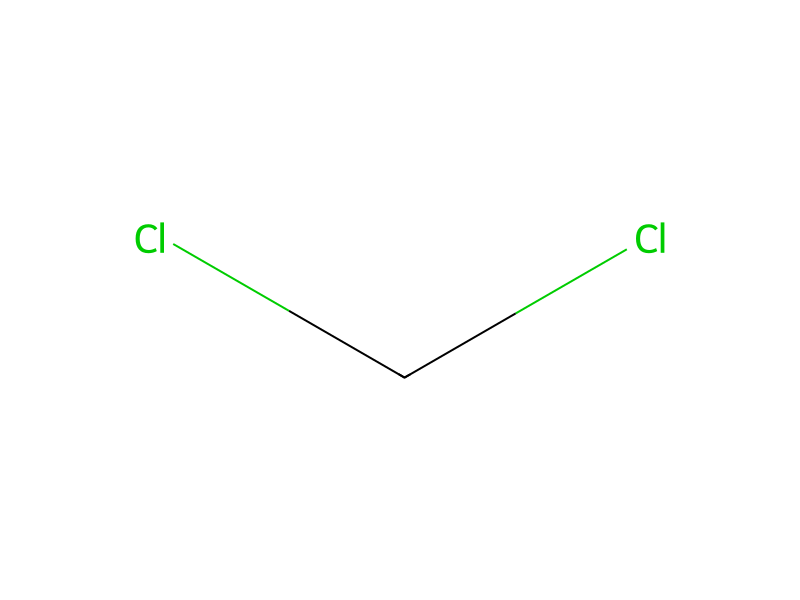
Procedure
4-[(2,3-dichloro-4-fluorophenyl)carbonyl]-2-piperazinone (I34) (0.210 g, 0.721 mmol) was dissolved in Dichloromethane (DCM) (3 mL), and to this was added triethyloxonium tetrafluoroborate (0.144 g, 0.757 mmol), the solution was stirred for 20 minutes before 2-pyrazinecarbohydrazide (commercially available from e.g. TimTec, J&W PharmLab or AKos Consulting, 0.120 g, 0.866 mmol) was added. The solution was then allowed to stir for an additional 30 minutes before the solvent was concentrated and n-butanol (3 mL) was added. The solution was then stirred, under argon and reflux, for 3 hours before being allowed to cool to room temperature. The solvent was then removed in vacuo and the remaining residue was purified by flash chromatography (Biotage SP4, 25M cartridge) with a gradient of 0-10% 2M NH3/MeOH in DCM. TLC confirmed product location and the solvent from the combined fractions was evaporated in vacuo. The remaining residue was then further purified by mass-directed automated HPLC, and the solvent evaporated in vacuo. The remaining residue was then triturated with ether and dried in a vacuum oven to yield the product in 0.112 g.
Workup
- additionwas added
- concentrationwas concentrated
- additionn-butanol (3 mL) was added
- stirringThe solution was then stirred, under argon
- temperaturereflux, for 3 hours
- customThe solvent was then removed in vacuo
- customthe remaining residue was purified by flash chromatography (Biotage SP4, 25M cartridge) with a gradient of 0-10% 2M NH3/MeOH in DCM
- customthe solvent from the combined fractions was evaporated in vacuo
- customThe remaining residue was then further purified
- customthe solvent evaporated in vacuo
- customThe remaining residue was then triturated with ether
- customdried in a vacuum oven
- customto yield the product in 0.112 g
Sources & evidence
- ORD record
- ord-8414c91653c746f5a2efc3a83124e025
- Source dataset
- uspto-grants-2013_08
- Patent number
- US08501946B2
Reaction notes
Loading…