Diisobutylaluminumhydride → (R)-2-((5-Bromo-2-chloropyrimidin-4-yl)amino)propanal
Reaction equation
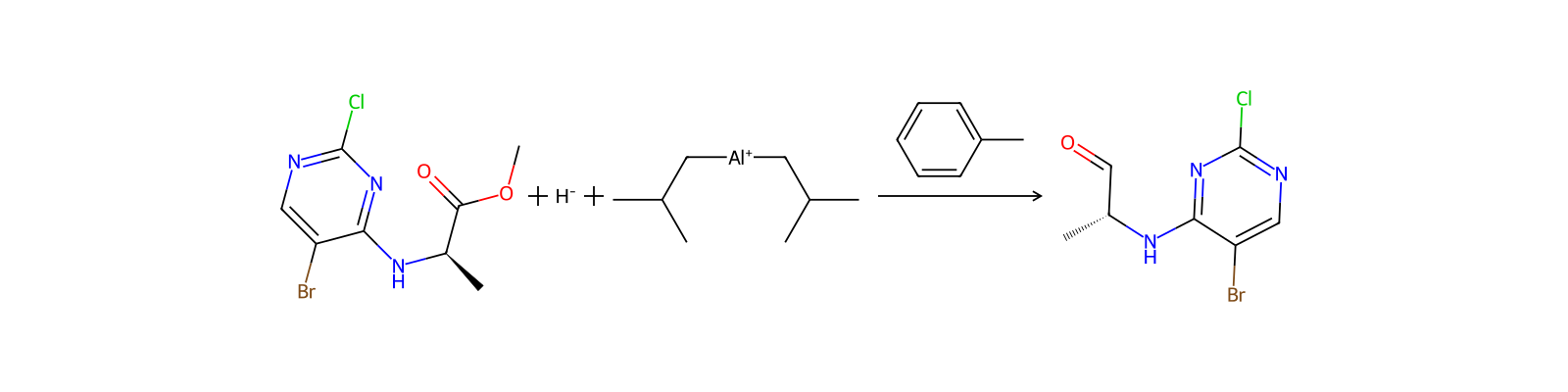
C[O:2][C:3](=O)[C@@H:4]([CH3:14])[NH:5][C:6]1[C:11]([Br:12])=[CH:10][N:9]=[C:8]([Cl:13])[N:7]=1.[H-].C([Al+]CC(C)C)C(C)C>C1(C)C=CC=CC=1>[Br:12][C:11]1[C:6]([NH:5][C@H:4]([CH3:14])[CH:3]=[O:2])=[N:7][C:8]([Cl:13])=[N:9][CH:10]=1Participants
4




Procedure
A solution of 40.0 g (135.8 mmol) of methyl-N-(5-bromo-2-chloropyrimidin-4-yl)-D-alaninate in 800 ml of toluene is mixed at −78° C. with 310 ml of a 1.2 molar solution of diisobutyl aluminum hydride. After 30 minutes, it is carefully quenched with methanol. The batch is heated to room temperature and diluted with 1000 ml of tert-butyl methyl ether. It is washed successively with 1N HCl (3×100 ml), saturated sodium bicarbonate solution (3×) and saturated NaCl solution (3×). The organic phase is dried (MgSO4), filtered and concentrated by evaporation. The remaining residue is purified by chromatography (hexane/ethyl acetate: 4:1-1:1). 22.5 g (83.9 mmol, corresponding to 62% of theory) of the product is obtained.
Workup
- customit is carefully quenched with methanol
- additiondiluted with 1000 ml of tert-butyl methyl ether
- washIt is washed successively with 1N HCl (3×100 ml), saturated sodium bicarbonate solution (3×) and saturated NaCl solution (3×)
- dry with materialThe organic phase is dried (MgSO4)
- filtrationfiltered
- concentrationconcentrated by evaporation
- customThe remaining residue is purified by chromatography (hexane/ethyl acetate: 4:1-1:1)
- custom22.5 g (83.9 mmol, corresponding to 62% of theory) of the product is obtained
Sources & evidence
- ORD record
- ord-baef29a25a9048d08352923b1ca1c28a
- Source dataset
- uspto-grants-2013_08
- Patent number
- US08507510B2
Reaction notes
Loading…