HuagongsheHuagongshe Chemistry Print Report · For research reference only
HRID 1892544Generated: October 31, 2026
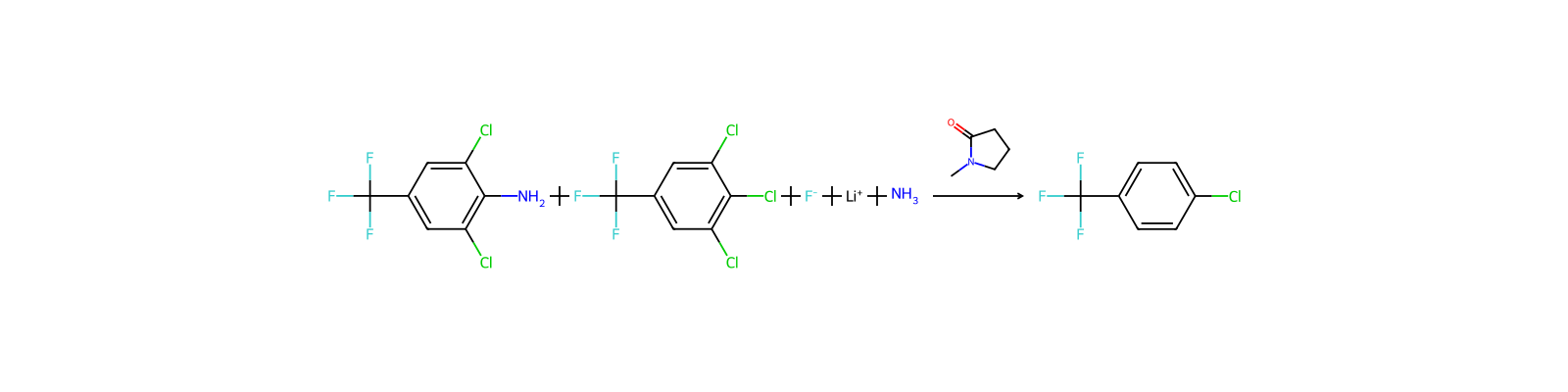
Ammonia → 1-Chloro-4-(trifluoromethyl)benzene
https://huagongshe.com/reaction/1892544
Participants
| Role | Name | HCID | Charge |
|---|
| Reactant | Ammonia | HCID 222 | — |
| Reactant | 4-Amino-3,5-dichlorobenzotrifluoride | HCID 141094 | — |
| Reactant | Lithium fluoride | HCID 224478 | — |
| Reactant | 1,2,3-Trichloro-5-(trifluoromethyl)benzene | HCID 2733399 | — |
| Solvent | N-methyl-2-pyrrolidone | HCID 13387 | — |
| Product | 1-Chloro-4-(trifluoromethyl)benzene | HCID 7394 | — |
Reaction Steps
WO00/35851/2000 talks about synthesis of 2,6-Dichloro-4-trifluoromethylaniline starting from 3,4,5-trichloro-benzotrifluoride in the presence of alkaline fluorides like lithium fluoride and ammonia in the presence of N-methylpyrrolidone at 250° C. to give 97% conversion and 87% selectivity. The main drawback of the above process is the synthesis of 3,4,5-trichlorobenzotrifluoride in high yield and purity. Chlorination of p-chlorobenzotrifluoride gives a mixture of 3,4,5-trichlorobenzotrifluoride in 72% GLC conversions, 3,4-dichloro and tetrachlorobenzotrifluoride. The process to get pure 3,4,5-isomer from this mixture by fractionation followed by crystallization is very tedious. Moreover in-spite of using very pure intermediates, substantial amount of an undesired isomer (3-amino-4,5-dichlorobenzotrifluoride) is also obtained.
Provenance & Evidence
| DOI | 10.6084/m9.figshare.5104873.v1 |
|---|
| Patent number | US08507693B2 |
|---|
| Source dataset | uspto-grants-2013_08 |
|---|
| ORD ID | ord-884e7aea6aaa4078ac2a59a4f2ac92c4 |
|---|
| Source note | uspto-grants-2013_08 |
|---|