O-Phenylenediamine → 2-Methyl-3-phenylquinoxaline
Reaction equation

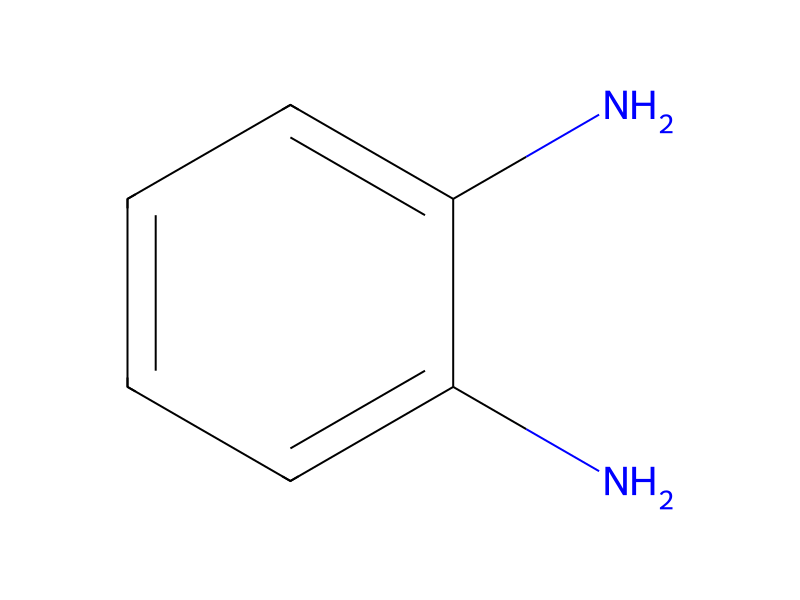
[C:1]1([C:7](=O)[C:8](=O)[CH3:9])[CH:6]=[CH:5][CH:4]=[CH:3][CH:2]=1.[C:12]1([NH2:19])[CH:17]=[CH:16][CH:15]=[CH:14][C:13]=1[NH2:18]>C(Cl)(Cl)Cl>[CH3:9][C:8]1[C:7]([C:1]2[CH:6]=[CH:5][CH:4]=[CH:3][CH:2]=2)=[N:19][C:12]2[C:13](=[CH:14][CH:15]=[CH:16][CH:17]=2)[N:18]=1Participants
4
Reactant 2

Product 1

Reagents, catalysts & solvents 1

Procedure
3.23 g of 1-phenyl-1,2-propanedione and 2.48 g of 1,2-phenylendiamine were refluxed in a chloroform solvent in nitrogen atmosphere for 4 hours. An organic layer was washed with 1 mol/L hydrochloric acid, and washed with a saturated salt solution, then, dried. The solvent was distilled off to give a ligand, 2-methyl-3-phenylquinoxaline (abbreviated as Hmpq) (pale orange powder, yields of 98%). A synthesis scheme of the step 1 (b-1) is represented as follows:
Workup
- washAn organic layer was washed with 1 mol/L hydrochloric acid
- washwashed with a saturated salt solution
- customdried
- distillationThe solvent was distilled off
Sources & evidence
- ORD record
- ord-f41c929013834a4784063dae892f481b
- Source dataset
- uspto-grants-2013_08
- Patent number
- US08512880B2
Reaction notes
Loading…