5-Bromo-2-chloropyrimidine → 2-Chloro-5-cyclobutylpyrimidine
Reaction equation

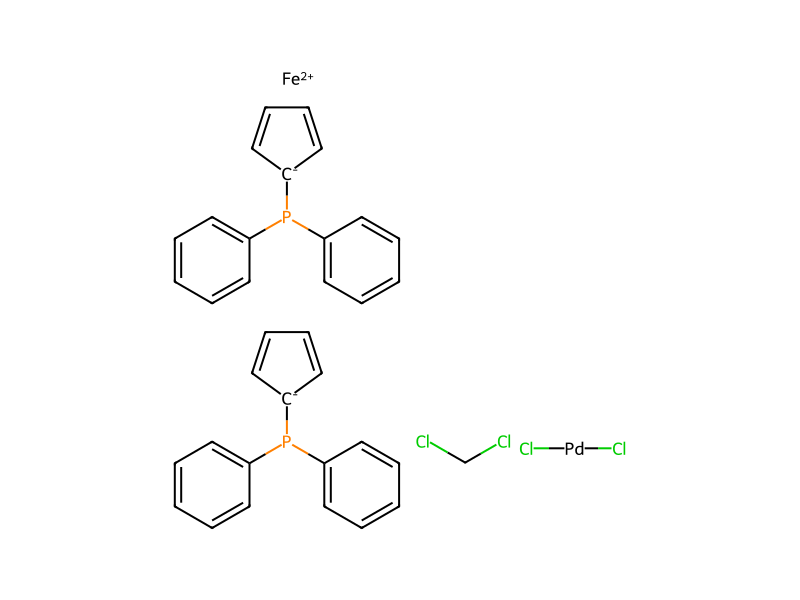
Br[C:2]1[CH:3]=[N:4][C:5]([Cl:8])=[N:6][CH:7]=1.[Br-].[CH:10]1([Zn+])[CH2:13][CH2:12][CH2:11]1>C1C=CC(P(C2C=CC=CC=2)[C-]2C=CC=C2)=CC=1.C1C=CC(P(C2C=CC=CC=2)[C-]2C=CC=C2)=CC=1.Cl[Pd]Cl.[Fe+2].C(Cl)Cl.ClCCl>[Cl:8][C:5]1[N:4]=[CH:3][C:2]([CH:10]2[CH2:13][CH2:12][CH2:11]2)=[CH:7][N:6]=1Participants



Procedure
To a 100 mL recovery flask containing 5-bromo-2-chloropyrimidine (816 mg, 4.22 mmol) was applied vacuum then placed under a nitrogen atmosphere. To the flask was added dichloromethane (3 mL), PdCl2(dppf)-CH2Cl2 (172 mg, 0.211 mmol) and then cyclobutylzinc(II) bromide (8.44 mL, 4.22 mmol, 1.3 M in THF) over 1-2 minutes. The reaction was quenched at 2 hours with 20 mL of saturated aqueous NH4Cl and 50 mL EtOAc. The organic layer was washed with 20 mL each of saturated aqueous NaHCO3 and then NaCl, dried with MgSO4, filtered and concentrated to 0.88 g of yellow oil containing some solids. This was purified by flash chromatography (5-10% EtOAc in hexanes) to yield product (253 mg, 1.50 mmol, 36%) as a faintly pale yellow liquid with some small amount of crystalline material. MS (ESI) 169.1 (M+1).
Workup
- customThe reaction was quenched at 2 hours with 20 mL of saturated aqueous NH4Cl and 50 mL EtOAc
- washThe organic layer was washed with 20 mL each of saturated aqueous NaHCO3
- dry with materialNaCl, dried with MgSO4
- filtrationfiltered
- concentrationconcentrated to 0.88 g of yellow oil
- additioncontaining some solids
- customThis was purified by flash chromatography (5-10% EtOAc in hexanes)
Sources & evidence
- ORD record
- ord-b4ed51d6eda4449a8affae5bf6776723
- Source dataset
- uspto-grants-2013_08
- Patent number
- US08513424B2
Reaction notes
Loading…