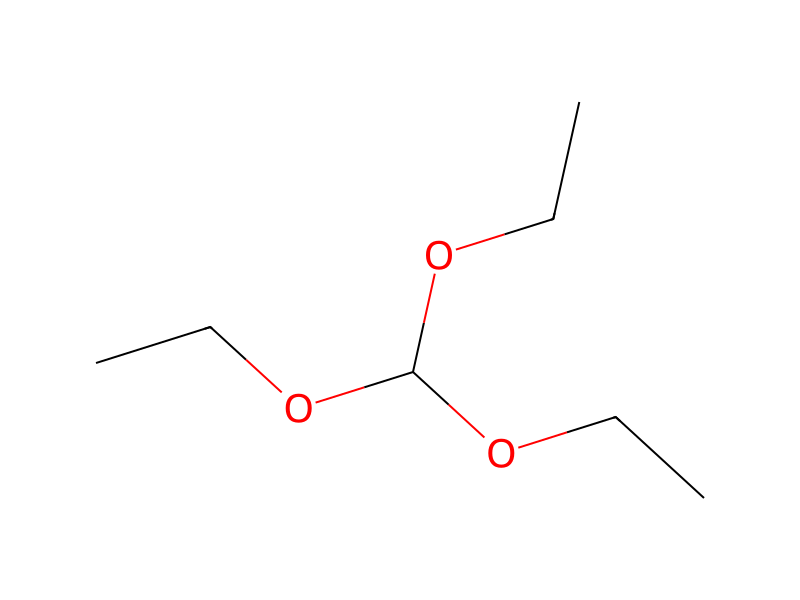
Ethyl orthoformate → 4-chloro-1-isobutyl-1H-imidazo[4,5-c]quinoline
Reaction equation

[Cl:1][C:2]1[C:11]([NH2:12])=[C:10]([NH:13][CH2:14][CH:15]([CH3:17])[CH3:16])[C:9]2[C:4](=[CH:5][CH:6]=[CH:7][CH:8]=2)[N:3]=1.[CH2:18](OC(OCC)OCC)C>C(O)C>[Cl:1][C:2]1[C:11]2[N:12]=[CH:18][N:13]([CH2:14][CH:15]([CH3:17])[CH3:16])[C:10]=2[C:9]2[CH:8]=[CH:7][CH:6]=[CH:5][C:4]=2[N:3]=1Participants
4
Reactant 2

Product 1

Reagents, catalysts & solvents 1

Procedure
A suspension of 2-chloro-N4 -(2-methylpropyl)-3,4-quinolinediamine (35 g) and triethylorthoformate (52.3 g, 2.5 eq) was heated at 145° C. for 10 h, during which time ethanol was removed by distillation. The resulting mixture was cooled to room temperature and the solid was removed by filtration. The solid was dissolved in hydrochloric acid (100 mL, 4N). The resulting solution was added to a solution of sodium hydroxide. The precipitate was filtered and washed with water to afford the product 4-chloro-1-(2-methylpropyl)-1H-imidazo[4,5-c]quinoline in 92% yield.
Workup
- customwas removed by distillation
- customthe solid was removed by filtration
- dissolutionThe solid was dissolved in hydrochloric acid (100 mL, 4N)
- additionThe resulting solution was added to a solution of sodium hydroxide
- filtrationThe precipitate was filtered
- washwashed with water
Sources & evidence
- ORD record
- ord-9b18781b9482496dbafe59faab97868a
- Source dataset
- uspto-grants-1996_11
- Patent number
- US05578727
Reaction notes
Loading…