Benzyl Alcohol → Toluene
Reaction equation

[C:1]1([CH2:7][CH2:8][OH:9])[CH:6]=[CH:5][CH:4]=[CH:3][CH:2]=1.C=[CH:11][C:12]1[CH:17]=[CH:16][CH:15]=[CH:14][CH:13]=1.C(O)C1C=CC=CC=1>[Co]>[C:1]1([CH2:7][CH2:8][OH:9])[CH:6]=[CH:5][CH:4]=[CH:3][CH:2]=1.[C:12]1([CH3:11])[CH:17]=[CH:16][CH:15]=[CH:14][CH:13]=1Participants
Reactant 3

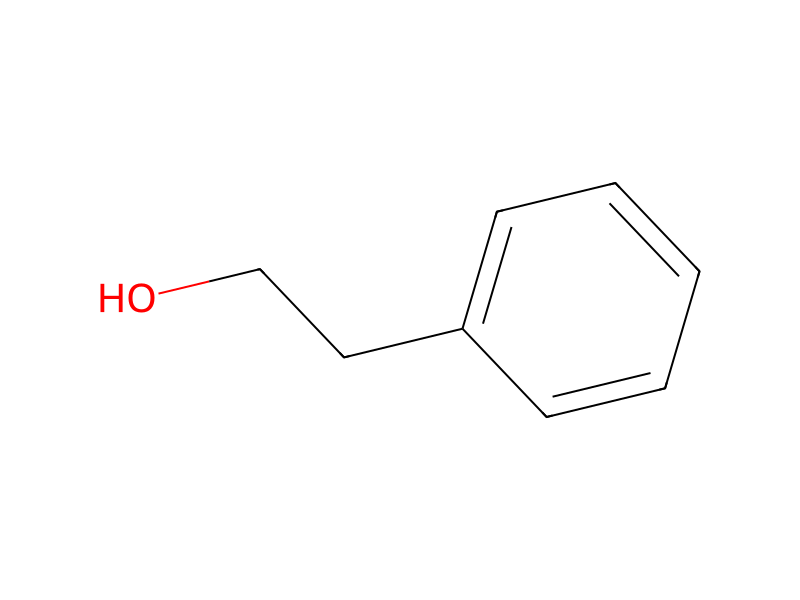

Product 2

Reagents, catalysts & solvents 1

Procedure
It has long been desirable to prepare 2-phenylethyl alcohol in a low cost process. This material is a valuable intermediate in the preparation of fragrances and of styrene, a commercial chemical with widely varying uses. In the past, it has been proposed that 2-phenylethyl alcohol be prepared from benzyl alcohol. For example, the reaction has been described by Wender, I. et al., J. Amer. Chem. Soc., 71 (1949), pages 4160-4161 wherein the use of a cobalt catalyst was described. This early work is summarized by Orchin in Advances in Catalysis, Vol. V (1953), pages 393-414. This auther reports that, at 183° C., a 50-60 percent yield of toluene and a 23-35 percent yield of 2-phenylethyl alcohol is obtained. Other workers have experimented with this reaction, particularly Y. B. Kryukov et al., Neftekhimiya, 1970, 10 (1), at page 83. Here, a vapor phase reaction is described over an iron, alumina, vanadium and potassium catalyst at 430° C. and 50 atmospheres pressure. Unfortunately, in this latter reaction extremely low selectivities to the 2-phenylethyl alcohol were obtained.
Workup
- customin the preparation of fragrances
- customat 183° C.
Sources & evidence
- ORD record
- ord-dd5f39631cec481e90366779477758b2
- Source dataset
- uspto-grants-1984_03
- Patent number
- US04435605
Reaction notes
Loading…