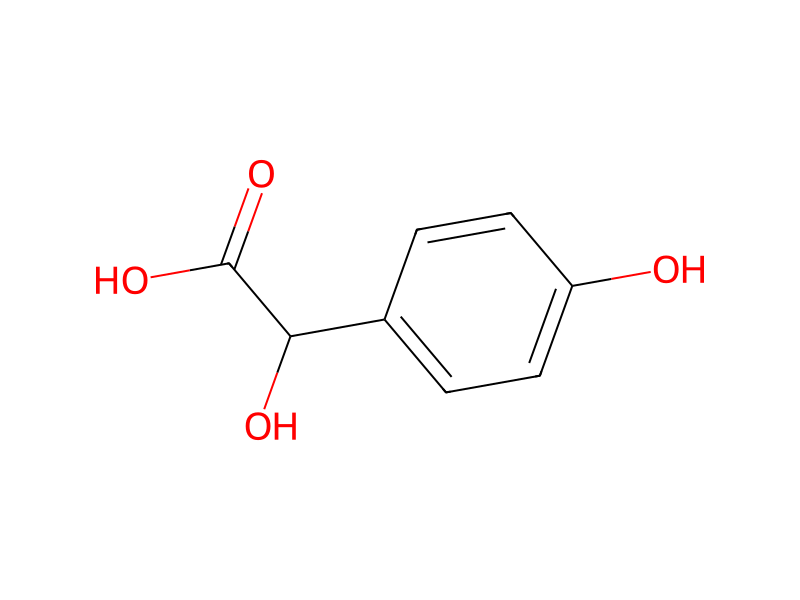
(+-)-4-Hydroxymandelic acid → HCID 21894392, compound
Reaction equation

[OH:1][C:2]1[CH:12]=[CH:11][C:5](C(O)C(O)=O)=[CH:4][CH:3]=1.CN(C(C1C=CC=CC=1)C#N)C.[OH:25][C:26]1[CH:35]=[CH:34][C:29]([CH:30](O)[C:31]#[N:32])=[CH:28][CH:27]=1.C1(O)C=CC=CC=1.S(=O)(=O)(O)O>>[OH:25][C:26]1[CH:35]=[CH:34][C:29]([CH:30]([C:5]2[CH:11]=[CH:12][C:2]([OH:1])=[CH:3][CH:4]=2)[C:31]#[N:32])=[CH:28][CH:27]=1Participants




Procedure
The afore-mentioned process can not advantageously be employed to prepare cyanobisphenols wherein R1 is hydrogen. When R1 and all R2 are hydrogen, the following procedure is effective to prepare the cyanobisphenol. 4-Hydroxybenzaldehyde is reacted with sodium cyanide in the presence of sodium bisulfite to yield 4-hydroxymandelonitrile, a cyanohydrin which has the following formula. ##STR13## The reaction and conditions are described in Landenberg et al., "Synthesis of 3-Hydroxy-2(3)-Benzofuranone and of 4-Hydroxymandelic Acid", 58 J. Amer Chem Soc. 1292 (1936) and in Taylor, et al, "a-N,N-Dimethylaminophenylacetonitrile", 5 Organic Synthesis 437 (1962). 4-Hydroxymandelonitrile is then reacted with excess phenol in the presence of sulfuric acid at a temperature of about 55° C. to 60° C. to yield bis-(4-hydroxyphenyl)acetonitrile: ##STR14## A description of the reaction and its conditions is found in Schraufstatter, "Darstellung und Reaktionen von 4,4'-Dihydroxydiphenylacetonitril", 295 Arch. Pharm. 269 (1962).
Workup
- custom##STR13## The reaction and conditions
Sources & evidence
- ORD record
- ord-c55625f41a9b4d0d8e683496a7e65092
- Source dataset
- uspto-grants-1989_06
- Patent number
- US04837293
Reaction notes
Loading…