2-Chlorotoluene → Benzene, 1,2-dichloro-3-methyl-
Reaction equation

[Cl:1][C:2]1[CH:7]=[CH:6][CH:5]=[CH:4][C:3]=1[CH3:8].[Cl:9]C1C=C(C)C=CC=1.ClC1C=CC(C)=CC=1>C1(C)C=CC=CC=1>[Cl:9][C:7]1[C:2]([Cl:1])=[C:3]([CH3:8])[CH:4]=[CH:5][CH:6]=1Participants
Reactant 3

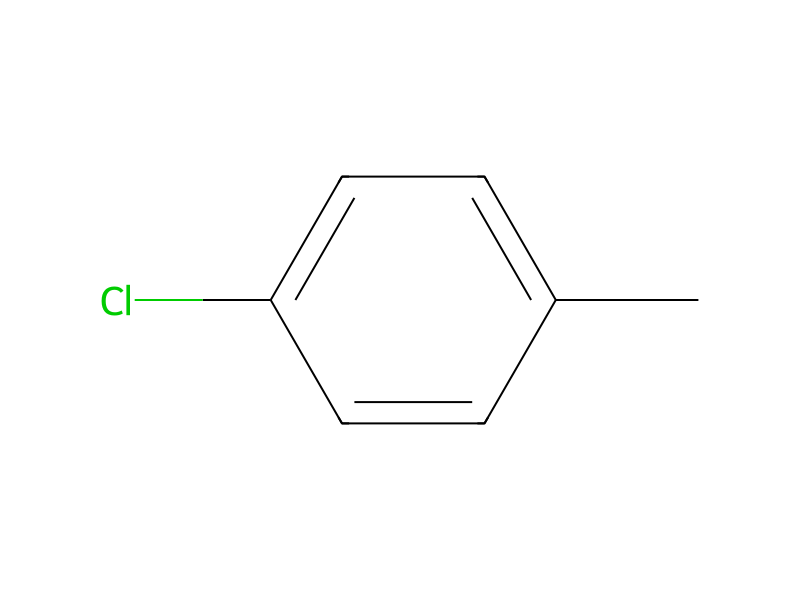

Product 1

Reagents, catalysts & solvents 1

Procedure
The chlorination of toluene in the presence of catalysts is known to produce the ring-chlorinated isomeric o-, m- and p-monochlorotoluenes in a ratio which varies according to the type of catalyst used and the reaction conditions chosen. Thus, for example, the chlorination of toluene at 50° C. in the presence of FeCl3 as catalyst up to a density of 1.043 g/cm3 (20° C.) leads to a product comprising 19% by weight of toluene, 49% by weight of o-chlorotoluene, 2% by weight of m-chlorotoluene and 25.5% by weight of p-chlorotoluene. Apart from these, 4.5% of dichlorotoluene are additionally formed (Ullmanns Encyl. der techn. Chemie [Ullmann's Encyclopedia of Industrial Chemistry] (1975), Volume 9, page 512). The use of TiCl4, SnCl4, WCl6 or ZrCl4 as catalysts at a chlorination temperature of 10°-30° C. increases the o-chlorotoluene content to 75% by weight (U.S. Pat. No. 3,000,975), while the use of disulfide dichloride and the metal chlorides mentioned or of sulfur and SbCl3 shifts the isomeric ratio in favor of p-chlorotoluene (U.S. Pat. No. 1,946,040). There is no successful instance of obtaining a single isomer by a suitable choice of catalyst or reaction conditions. All these processes therefore require a subsequent separation of the reaction mixture into the pure isomers, which separation is customarily carried out in two stages where, in a first working-up stage, which is expensive in outlay and energy, o-chlorotoluene (boiling point 158.5° C.) is separated as top product by distillation, for example in a bubble cap column having over 200 theoretical plates, from a bottom comprising m- and p-chlorotoluene. Due to the small difference in the boiling points of these isomers (161.2° C. and 161.5° C. respectively), it is no longer possible to separate their mixture by distillation. Pure p-chlorotoluene (melting point 7.6° C.) must therefore be separated in a second step by crystallization from the m-isomer, which has a lower melting point (melting point -48.7° C.).
Workup
- customthe reaction conditions
- customat 50° C.
- customup to a density of 1.043 g/cm3 (20° C.)
Sources & evidence
- ORD record
- ord-10a15fba97fc44248cd7505e1e8392d5
- Source dataset
- uspto-grants-1987_03
- Patent number
- US04650915
Reaction notes
Loading…