ethyl 3-(3,4-dichlorophenyl)-3-oxopropanoate → HCID 178515609, compound
Reaction equation
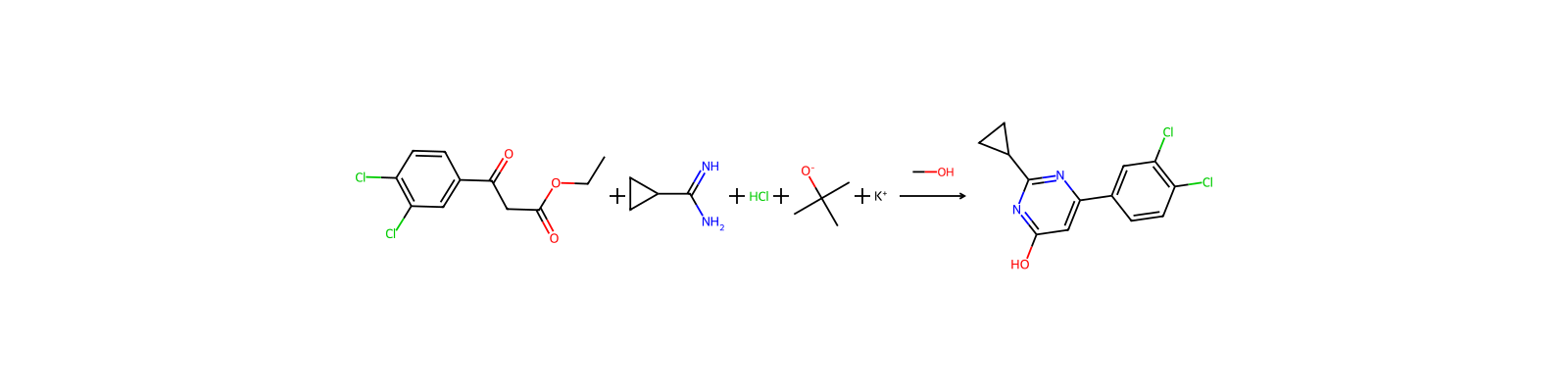
C(O[C:4](=[O:16])[CH2:5][C:6]([C:8]1[CH:13]=[CH:12][C:11]([Cl:14])=[C:10]([Cl:15])[CH:9]=1)=O)C.[CH2:17]1[CH:19]([C:20]([NH2:22])=[NH:21])[CH2:18]1.Cl.CC(C)([O-])C.[K+]>CO>[CH:19]1([C:20]2[N:22]=[C:4]([OH:16])[CH:5]=[C:6]([C:8]3[CH:13]=[CH:12][C:11]([Cl:14])=[C:10]([Cl:15])[CH:9]=3)[N:21]=2)[CH2:17][CH2:18]1Participants
5





Procedure
To a solution consisting of 3-(3,4-dichlorophenyl)-3-oxo-propionic acid ethyl ester (252 mg, 0.967 mmol) and MeOH were added cyclopropylcarbamidine hydrochloride (140 mg, 1.16 mmol) and potassium tert-butoxide (266 mg, 2.37 mmol). The reaction mixture was stirred at rt overnight, then concentrated. Water and CH2Cl2 were added, and the mixture was adjusted to pH 7 with glacial acetic acid. The layers were separated, and the aqueous phase was extracted with EtOAc. The organics were combined, dried (Na2SO4), and concentrated. The crude residue was purified (FCC) to give the title compound as a white solid (133 mg, 49%).
Workup
- concentrationconcentrated
- additionWater and CH2Cl2 were added
- customThe layers were separated
- extractionthe aqueous phase was extracted with EtOAc
- dry with materialdried (Na2SO4)
- concentrationconcentrated
- customThe crude residue was purified (FCC)
Sources & evidence
- ORD record
- ord-e12d42db77844f379676e6227e9d8550
- Source dataset
- uspto-grants-2013_12
- Patent number
- US08598202B2
Reaction notes
Loading…