HuagongsheHuagongshe Chemistry Print Report · For research reference only
HRID 1908285Generated: October 27, 2026
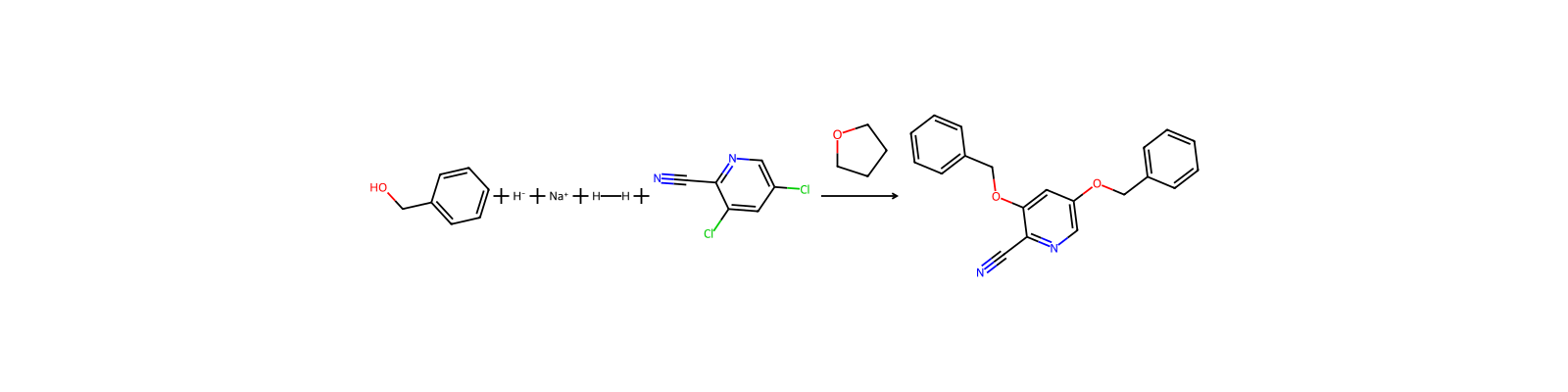
Benzyl Alcohol → 3,5-Bis(benzyloxy)picolinonitrile
https://huagongshe.com/reaction/1908285
Participants
| Role | Name | HCID | Charge |
|---|
| Reactant | Benzyl Alcohol | HCID 244 | — |
| Reactant | Sodium hydride | HCID 24758 | — |
| Reactant | 3,5-Dichloro-2-cyanopyridine | HCID 2769699 | — |
| Reactant | HCID 178418361 | HCID 178418361 | — |
| Solvent | Tetrahydrofuran | HCID 8028 | — |
| Product | 3,5-Bis(benzyloxy)picolinonitrile | HCID 53487994 | 94% |
Reaction Steps
To an 80 mL microwave pressure vessel is charged dry THF (30 mL) and benzyl alcohol (6.32 mL, 61.1 mmol). The solution is cooled to 0° C. and sodium hydride (2.44 g of a 60% dispersion in mineral oil, 61.1 mmol) is added in portions. The reaction mixture is gradually allowed to warm to room temperature with efficient stirring until the evolution of hydrogen gas ceases. The solution is re-cooled to 0° C. and 3,5-dichloro-2-cyanopyridine (5.00 g, 29.1 mmol) is added, and the solution is transferred to an unfocussed Mars 5 CEM microwave reactor to 190° C., 300 W and held for 5 hours. The reaction mixture is quenched with H2O, concentrated under reduced pressure, diluted with EtOAc and washed with 2M Na2CO3, H2O and saturated aqueous NaCl. The organic layer is dried (MgSO4), filtered and concentrated under reduced pressure to give a brown solid. The crude solid is purified over silica (EtOAc:heptane, gradient 1:1 to 1:0) to afford 8.6 g (94% yield) of the desired compound as an orange solid. 1H NMR (400 MHz, CDCl3) δ ppm 7.96 (1H, d, J=2.2 Hz), 7.25-7.37 (10H, m), 6.78 (1H, d, J=2.2 Hz), 5.10 (2H, s), 5.03 (2H, s). HPLC-MS: m/z 317 [M+H]+.
Provenance & Evidence
| DOI | 10.6084/m9.figshare.5104873.v1 |
|---|
| Patent number | US08598210B2 |
|---|
| Source dataset | uspto-grants-2013_12 |
|---|
| ORD ID | ord-f958edb359fd451893ddcd5e1819b457 |
|---|
| Source note | uspto-grants-2013_12 |
|---|