Ethyl diazoacetate → HCID 91324394, compound
Reaction equation
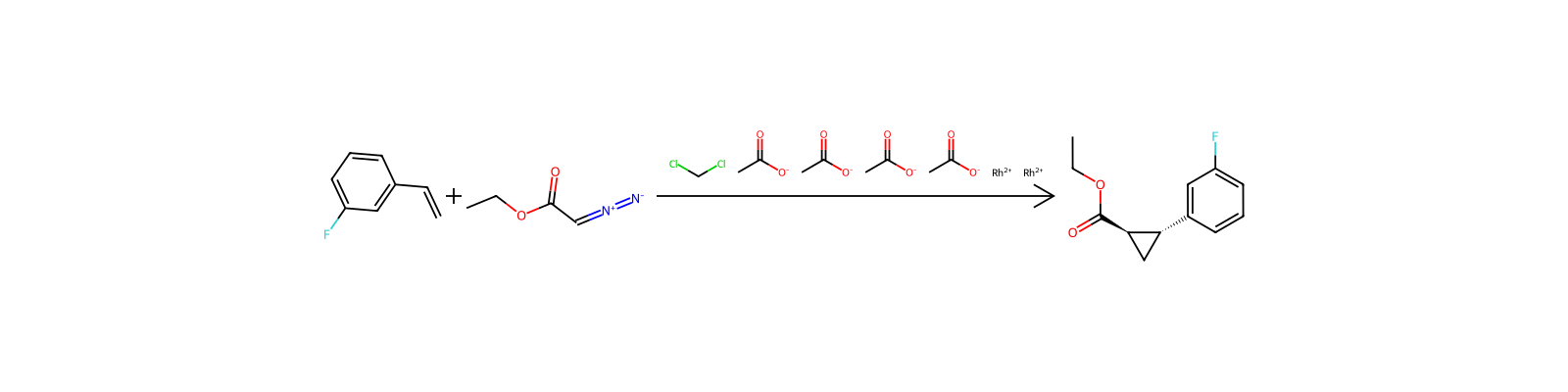
[F:1][C:2]1[CH:3]=[C:4]([CH:7]=[CH:8][CH:9]=1)[CH:5]=[CH2:6].[CH2:10]([O:12][C:13](=[O:17])[CH:14]=[N+]=[N-])[CH3:11]>C(Cl)Cl.CC([O-])=O.CC([O-])=O.CC([O-])=O.CC([O-])=O.[Rh+2].[Rh+2]>[CH2:10]([O:12][C:13]([C@@H:14]1[CH2:6][C@H:5]1[C:4]1[CH:7]=[CH:8][CH:9]=[C:2]([F:1])[CH:3]=1)=[O:17])[CH3:11]Participants
Reactant 2


Product 1

Reagents, catalysts & solvents 2


Procedure
Around-bottomed flask was charged with 3-fluorostyrene (13.0 g, 0.107 mol) in anhydrous methylene chloride (130 mL). To this mixture was added rhodium acetate dimer (1.30 g, cat amount). A solution of ethyldiazoacetate (33.28 g, 0.291 mol) in anhydrous methylene chloride (130 mL) was added to the reaction via a syringe pump over 5 h and stirred at room temperature for 1 h in darkness. The reaction mixture was filtered through a plug of celite, which was washed with water followed by brine. The organic layer was dried over Na2SO4 and evaporated to dryness. Flash chromatography (silica, EtOAc/petroleum ether 1:9) gave rac-trans 2-(3-fluoro-phenyl)-cyclopropanecarboxylic acid ethyl ester (13.0 g, 59%) as a colorless liquid sufficiently pure for the next step.
Workup
- filtrationThe reaction mixture was filtered through a plug of celite, which
- washwas washed with water
- dry with materialThe organic layer was dried over Na2SO4
- customevaporated to dryness
Sources & evidence
- ORD record
- ord-3658294eee614720b4f77f55f9772e90
- Source dataset
- uspto-grants-2013_12
- Patent number
- US08598213B2
Reaction notes
Loading…