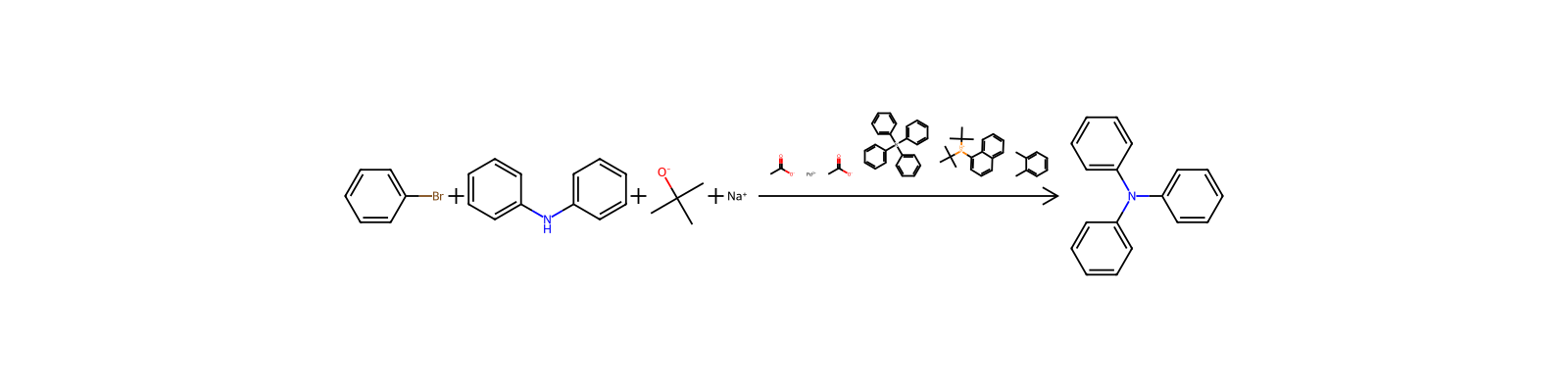
Participants
| Role | Name | HCID | Charge |
|---|
| Reactant | Bromobenzene | HCID 7961 | — |
| Reactant | Diphenylamine | HCID 11487 | — |
| Reactant | Sodium t-butoxide | HCID 23676156 | — |
| Catalyst | palladium(II) acetate | HCID 167845 | — |
| Catalyst | Di-tert-butyl-1-naphthylphosphonium tetraphenylborate | HCID 23136633 | — |
| Solvent | O-Xylene | HCID 7237 | — |
| Product | Triphenylamine | HCID 11775 | 85% |
Reaction Steps
A 100-ml four-necked flask was equipped with a stirrer, a thermometer and a reflux condenser. 7.536 g (48 mmol) of bromobenzene, 6.769 g (40 mmol) of diphenylamine, 4.613 g (48 mmol) of sodium-tert-butoxide, 0.009 g (0.04 mmol) of palladium (II) acetate and 5 ml of xylene were weighed in the flask, followed by stirring. Further, 0.071 g (0.12 mmol) of di-tert-butyl-1-naphthylphosphonium tetraphenylborate obtained in Example B-11 was weighed in air and added into the flask. The flask was purged with argon, followed by stirring at 125° C. for 4 hours. After the completion of the reaction, 45 ml of xylene and 50 ml of saturated sodium chloride solution were added, followed by separation. The organic phase was purified by column chromatography to afford 8.341 g of triphenylamine (yield: 85 mol % based on diphenylamine). The melting point was 125-126° C.
Provenance & Evidence
| DOI | 10.6084/m9.figshare.5104873.v1 |
|---|
| Patent number | US08604249B2 |
|---|
| Source dataset | uspto-grants-2013_12 |
|---|
| ORD ID | ord-a51dc61d8bfb415a975508923d513688 |
|---|
| Source note | uspto-grants-2013_12 |
|---|