Sodium Carbonate → 6-(4-chloro-phenyl)-1H-quinolin-2-one
Reaction equation

Br[C:2]1[CH:3]=[C:4]2[C:9](=[CH:10][CH:11]=1)[NH:8][C:7](=[O:12])[CH:6]=[CH:5]2.C([O-])([O-])=O.[Na+].[Na+].[Cl:19][C:20]1[CH:25]=[CH:24][C:23](OB(O)O)=[CH:22][CH:21]=1>O1CCOCC1.CO>[Cl:19][C:20]1[CH:25]=[CH:24][C:23]([C:2]2[CH:3]=[C:4]3[C:9](=[CH:10][CH:11]=2)[NH:8][C:7](=[O:12])[CH:6]=[CH:5]3)=[CH:22][CH:21]=1Participants
6
Reactant 3

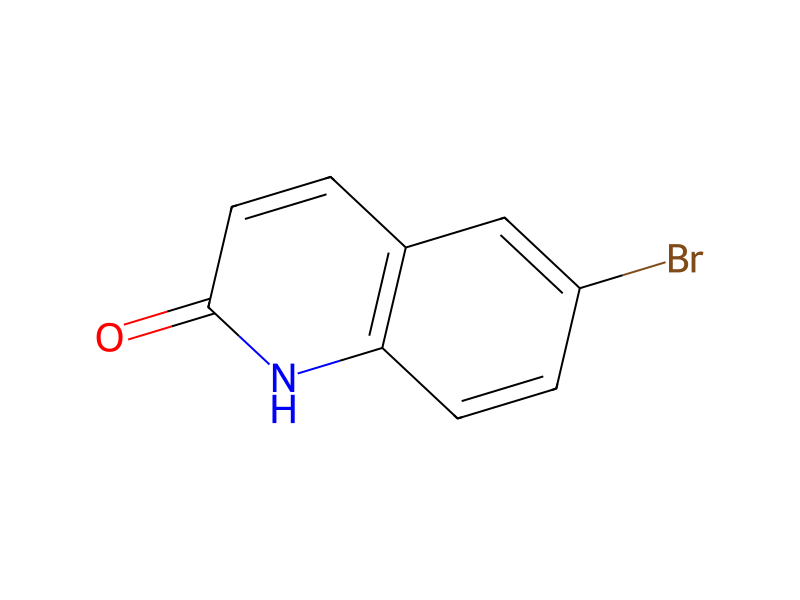

Product 1

Reagents, catalysts & solvents 2


Conditions
- Temperature
- 110 °C
Procedure
A solution of 22.7 g (0.101 mol) 6-bromo-1H-quinolin-2-one in 380 mL 1,4-dioxane and 380 mL MeOH is combined with 141.5 ml (0.283 ml) 2 M Na2CO3 solution and saturated with argon. Then 3.735 g (3.23 mmol) tetrakis-triphenyl-phosphane-palladium and 4-chlorophenylboric acid are added successively. The reaction mixture is heated to 110° C. for four hours and then evaporated down to a volume of 300 mL. 1.2 L water are added and the precipitate is filtered off. The solid is dried at 55° C. in the drying cupboard, washed with diisopropylether and dried again.
Workup
- customevaporated down to a volume of 300 mL
- addition1.2 L water are added
- filtrationthe precipitate is filtered off
- customThe solid is dried at 55° C. in the drying cupboard
- washwashed with diisopropylether
- customdried again
Sources & evidence
- ORD record
- ord-e1ac63973a5b4479aa4780e6dafbb9ab
- Source dataset
- uspto-grants-2013_12
- Patent number
- US08618132B2
Reaction notes
Loading…