Potassium Carbonate → 7-Nitro-4-(2-(pyrrolidin-1-yl)ethyl)-2H-benzo[b][1,4]oxazin-3(4H)-one
Reaction equation

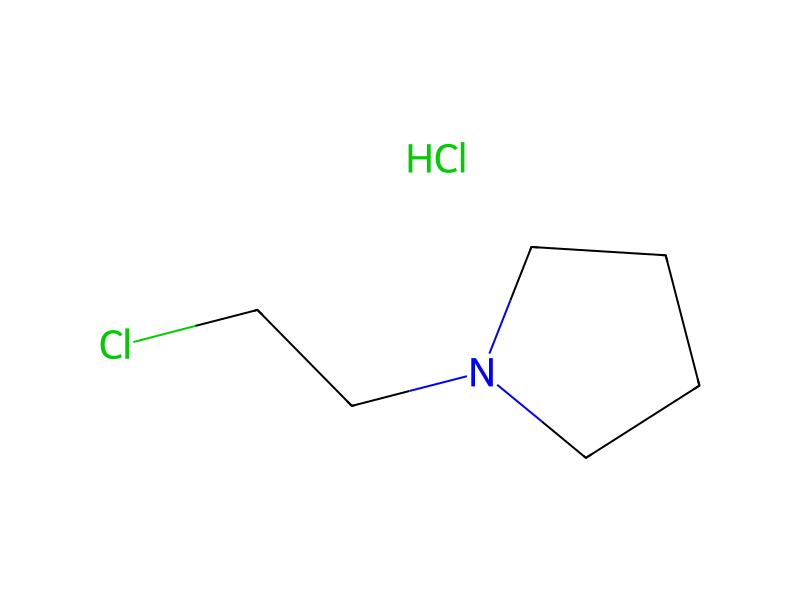
[N+:1]([C:4]1[CH:5]=[CH:6][C:7]2[NH:12][C:11](=[O:13])[CH2:10][O:9][C:8]=2[CH:14]=1)([O-:3])=[O:2].Cl.Cl[CH2:17][CH2:18][N:19]1[CH2:23][CH2:22][CH2:21][CH2:20]1.C([O-])([O-])=O.[K+].[K+]>CN(C=O)C.O>[N+:1]([C:4]1[CH:5]=[CH:6][C:7]2[N:12]([CH2:17][CH2:18][N:19]3[CH2:23][CH2:22][CH2:21][CH2:20]3)[C:11](=[O:13])[CH2:10][O:9][C:8]=2[CH:14]=1)([O-:3])=[O:2]Participants
Reactant 3


Product 1

Reagents, catalysts & solvents 2


Conditions
- Temperature
- 100 °C
Procedure
A suspension of 7-nitro-2H-benzo[b][1,4]oxazin-3(4H)-one (0.5 g, 2.575 mmol), 1-(2-chloroethyl)pyrrolidine hydrochloride (0.43 g, 2.575 mmol) and K2CO3 (1.06 g, 7.726 mmol) in dry DMF (5 mL) was stirred at 100° C. overnight (18 hours). The reaction was brought to room temperature, diluted with water (100 mL), and the product was extracted into ethyl acetate (2×25 mL). The combined ethyl acetate layers were washed with brine (20 mL) and dried (Na2SO4). The solvent was evaporated, and the crude material was purified by column chromatography (3:97 (2M NH3 in MeOH):CH2Cl2) to obtain the title compound (0.49 g, 65%) as a solid. 1H NMR (DMSO-d6) δ 1.62-1.70 (m, 4H), 2.46-2.54 (m, 4H, merged with DMSO-d6 resonance), 2.60 (t, 2H, J=6.9 Hz), 4.08 (t, 2H, J=6.9 Hz), 4.80 (s, 2H), 7.44 (d, 1H, J=9.3 Hz), 7.80 (d, 1H, J=2.4 Hz), 7.96 (dd, 1H, J=2.7, 9.0 Hz); ESI-MS (m/z, %): 292 (MH+, 100).
Workup
- customwas brought to room temperature
- extractionthe product was extracted into ethyl acetate (2×25 mL)
- washThe combined ethyl acetate layers were washed with brine (20 mL)
- dry with materialdried (Na2SO4)
- customThe solvent was evaporated
- customthe crude material was purified by column chromatography (3:97 (2M NH3 in MeOH):CH2Cl2)
Sources & evidence
- ORD record
- ord-34fd0b59b0d24611856987d40c5a8a20
- Source dataset
- uspto-grants-2013_12
- Patent number
- US08618286B2
Reaction notes
Loading…