Diisopropylethylamine → 1H-Pyrazole, 5-[(3,3-difluoro-1-azetidinyl)methyl]-1-methyl-3-nitro-
Reaction equation

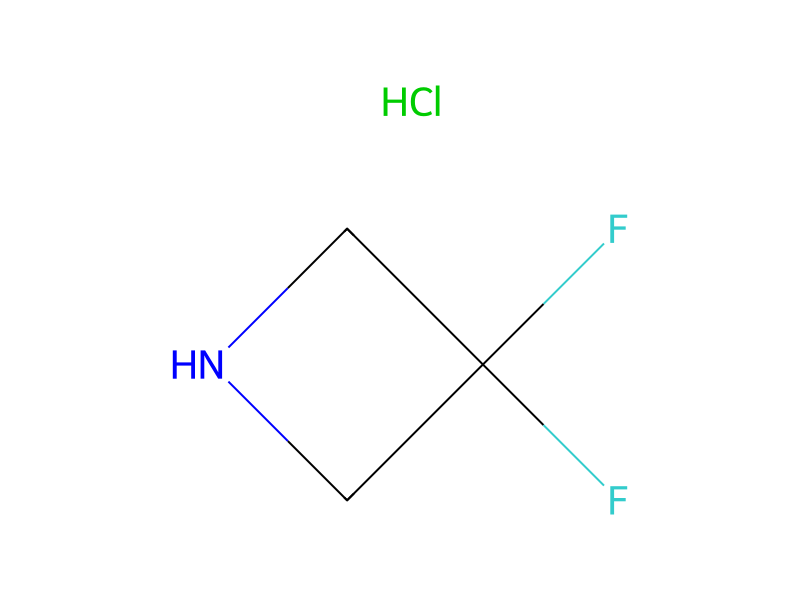
Br[CH2:2][C:3]1[N:7]([CH3:8])[N:6]=[C:5]([N+:9]([O-:11])=[O:10])[CH:4]=1.Cl.[F:13][C:14]1([F:18])[CH2:17][NH:16][CH2:15]1.CCN(C(C)C)C(C)C>CN(C=O)C>[F:13][C:14]1([F:18])[CH2:17][N:16]([CH2:2][C:3]2[N:7]([CH3:8])[N:6]=[C:5]([N+:9]([O-:11])=[O:10])[CH:4]=2)[CH2:15]1Participants
Reactant 3


Product 1

Reagents, catalysts & solvents 1

Conditions
- Temperature
- 65 °C
Procedure
A sealed tube with a magnetic stirrer was charged with DMF (5 mL), 5-(Bromomethyl)-1-methyl-3-nitro-1H-pyrazole 156d (0.39 g, 1.78 mmol), 3,3-difluoroazetidine hydrochloride (276 mg, 2.13 mmol) and DIPEA (0.8 mL, 4.45 mmol). The reaction mixture was heated at 65° C. for 3-5 h. After this time the reaction was concentrated to dryness under reduced pressure, and the resulting residue was diluted with a mixture of Ethyl Acetate (15 mL) and water (15 mL). The aqueous layer was separated and extracted with Ethyl Acetate (2×15 mL). The combined organic extracts were dried over sodium sulfate and concentrated under reduced pressure to afford a quantitative yield of 156e as yellow oil, which was used without further purification for the next step. MS (ESI+) m/z 233.0 (M+H).
Workup
- concentrationAfter this time the reaction was concentrated to dryness under reduced pressure
- additionthe resulting residue was diluted with a mixture of Ethyl Acetate (15 mL) and water (15 mL)
- customThe aqueous layer was separated
- extractionextracted with Ethyl Acetate (2×15 mL)
- dry with materialThe combined organic extracts were dried over sodium sulfate
- concentrationconcentrated under reduced pressure
Sources & evidence
- ORD record
- ord-e18b4a3b71074817afcaec5ef5a08628
- Source dataset
- uspto-grants-2013_12
- Patent number
- US08618107B2
Reaction notes
Loading…