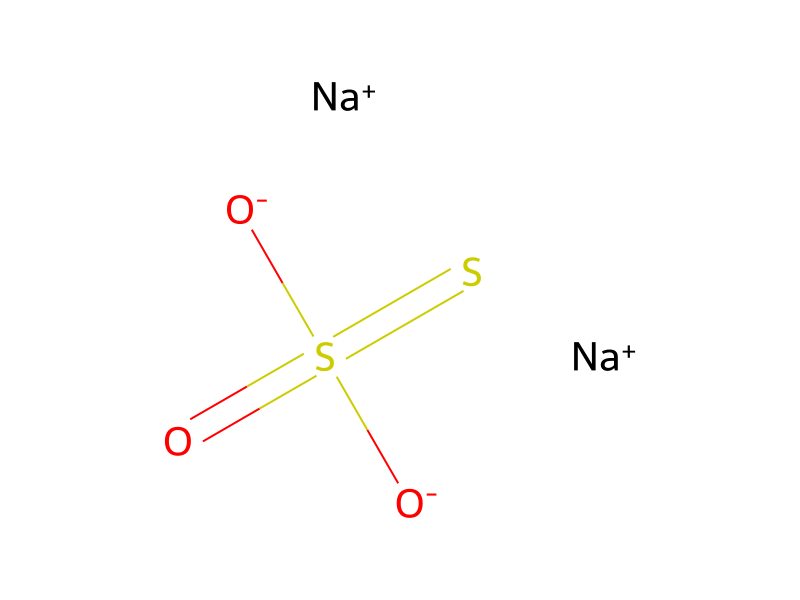
Sodium Thiosulfate → 2-Bromo-3-chlorobenzaldehyde
Reaction equation

[Br:1][C:2]1[C:7]([Cl:8])=[CH:6][CH:5]=[CH:4][C:3]=1[CH2:9][OH:10].C(=O)([O-])O.[Na+].S([O-])([O-])(=O)=S.[Na+].[Na+]>C(Cl)Cl>[Br:1][C:2]1[C:7]([Cl:8])=[CH:6][CH:5]=[CH:4][C:3]=1[CH:9]=[O:10]Participants
Reactant 3


Product 1

Reagents, catalysts & solvents 1

Procedure
A solution of (2-bromo-3-chloro phenyl)methanol (4.73 g, 21.24 mmol), which had been obtained in Reference example 7 (7a), in methylene chloride (120 mL) was added with 1,1,1-tris(acetoxy)-1,1-dihydro-1,2-benziodoxol-3-(1H)-one (10.8 g, 25.49 mmol) under ice cooling, and stirred at room temperature for 2 hours. The reaction solution was added with a mixture of saturated aqueous sodium hydrogen carbonate solution (60 mL) and saturated aqueous sodium thiosulfate solution (30 mL), and then stirred at room temperature for 0.5 hours. The mixture obtained was extracted with dichloromethane (90 mL×2). After that, the organic layers were combined and dried over anhydrous sodium sulfate. The solvent was distilled off under reduced pressure. The residue was purified by silica gel chromatography (n-hexane/ethyl acetate=5/1) to give the title compound as a white solid (4.36 g, yield 94%).
Workup
- stirringstirred at room temperature for 0.5 hours
- customThe mixture obtained
- extractionwas extracted with dichloromethane (90 mL×2)
- dry with materialdried over anhydrous sodium sulfate
- distillationThe solvent was distilled off under reduced pressure
- customThe residue was purified by silica gel chromatography (n-hexane/ethyl acetate=5/1)
Sources & evidence
- ORD record
- ord-68bf3a7e0ff641cab09c38b7faf73b9d
- Source dataset
- uspto-grants-2012_05
- Patent number
- US08173631B2
Reaction notes
Loading…