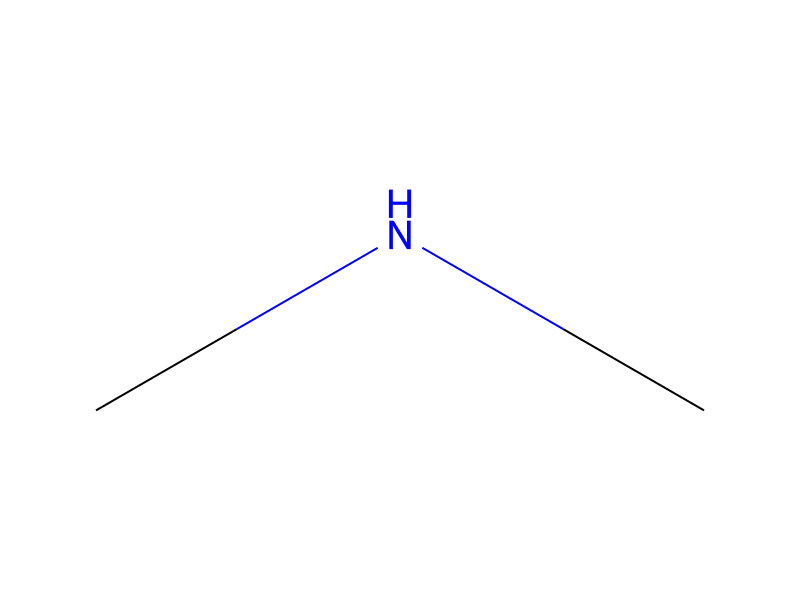
Dimethylamine → HCID 86619738, compound
Reaction equation

[Br:1][C:2]1[CH:7]=[N:6][C:5]([Cl:8])=[C:4]2[NH:9][CH:10]=[CH:11][C:3]=12.[CH2:12]=O.[CH3:14][NH:15][CH3:16]>CC(O)=O>[Br:1][C:2]1[CH:7]=[N:6][C:5]([Cl:8])=[C:4]2[NH:9][CH:10]=[C:11]([CH2:14][N:15]([CH3:12])[CH3:16])[C:3]=12Participants
5
Reactant 3


Product 1

Reagents, catalysts & solvents 1

Conditions
- Temperature
- 100 °C
Procedure
A mixture of 4-bromo-7-chloro-1H-pyrrolo[2,3-c]pyridine (Zhang et al., J. Org. Chem., 2002, 67, 2345-2347) (200 mg, 0.864 mmol), formaldehyde (37 wt. % in H2O, 0.500 mL, 6.17 mmol), and dimethylamine (40 wt. % in H2O, 1.00 mL, 8.88 mmol) in AcOH (6 mL) was heated in a microwave reactor at 100° C. for 40 min. The solvent was removed under reduced pressure. The crude product was partitioned between CH2Cl2 (15 mL) and saturated NaHCO3 (10 mL). The layers were separated and the organic layer was dried over Na2SO4, filtered, and concentrated in vacuo. Purification of the crude product by silica gel chromatography, eluting with a gradient of CH2Cl2:MeOH—100:0 to 90:10, gave the title compound. MS: m/z=290 (M+1).
Workup
- customThe solvent was removed under reduced pressure
- customThe crude product was partitioned between CH2Cl2 (15 mL) and saturated NaHCO3 (10 mL)
- customThe layers were separated
- dry with materialthe organic layer was dried over Na2SO4
- filtrationfiltered
- concentrationconcentrated in vacuo
- customPurification of the crude product by silica gel chromatography
- washeluting with a gradient of CH2Cl2
Sources & evidence
- ORD record
- ord-08f1d43257bb4c239c0c6c37bfaa0f7f
- Source dataset
- uspto-grants-2012_05
- Patent number
- US08173655B2
Reaction notes
Loading…