Sodium Carbonate → 4-(3-Cyanophenyl)-1-methoxyisoquinoline
Reaction equation

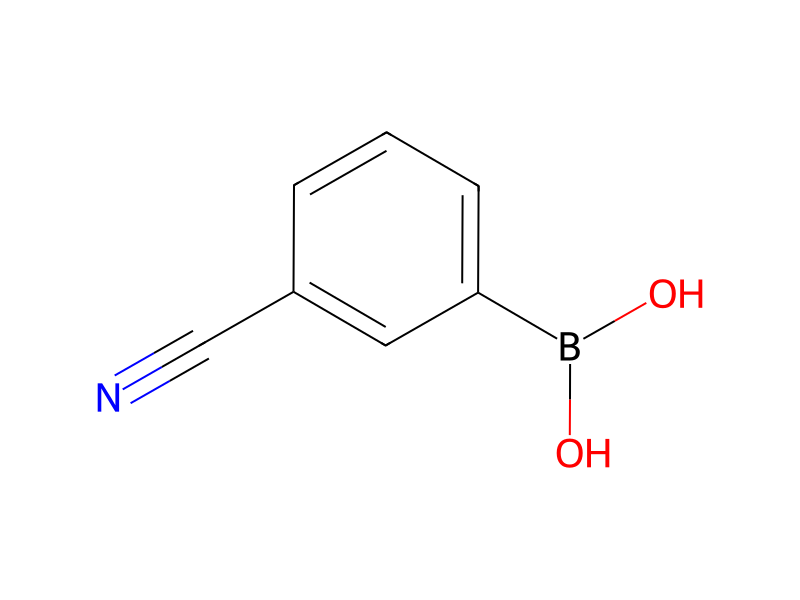
Br[C:2]1[C:11]2[C:6](=[CH:7][CH:8]=[CH:9][CH:10]=2)[C:5]([O:12][CH3:13])=[N:4][CH:3]=1.[C:14]([C:16]1[CH:17]=[C:18](B(O)O)[CH:19]=[CH:20][CH:21]=1)#[N:15].C(=O)([O-])[O-].[Na+].[Na+]>C1(P(C2C=CC=CC=2)C2C=CC=CC=2)C=CC=CC=1.C1(P(C2C=CC=CC=2)C2C=CC=CC=2)C=CC=CC=1.C1(P(C2C=CC=CC=2)C2C=CC=CC=2)C=CC=CC=1.C1(P(C2C=CC=CC=2)C2C=CC=CC=2)C=CC=CC=1.[Pd].C1(C)C=CC=CC=1>[C:14]([C:16]1[CH:21]=[C:20]([C:2]2[C:11]3[C:6](=[CH:7][CH:8]=[CH:9][CH:10]=3)[C:5]([O:12][CH3:13])=[N:4][CH:3]=2)[CH:19]=[CH:18][CH:17]=1)#[N:15]Participants
6
Reactant 3


Product 1

Reagents, catalysts & solvents 2


Procedure
A stirred mixture of 4-bromo-1-methoxyisoquinoline (1.19 g, 4.72 mmol), 3-cyanophenylboronic acid (1.04 g, 7.08 mmol), palladium tetrakis(triphenylphosphine) (0.33 g. 0.28 mmol), 2 m aq sodium carbonate (4.72 mmol) and toluene (30 mL) is heated 42 hr at reflux under a nitrogen atmosphere. After cooling, the solvent is removed and the residue is purified by chromatography eluting with cyclohexane-2.5 to 6% ethyl acetate. Product containing fractions are combined and concentrated to afford 4-(3-cyanophenyl)-1-methoxyisoquinoline (200 mg, 15.5% yield). LC/MS: MS m/e=275 (M+H); RT 4.38; 1H NMR (δ ppm): 8.22 (1H, d), 7.98 (1H, d), 7.83 (1H, s); 7.78 (1H, t), 7.65 (2H, m), 7.58 (1H, t), 7.18 (1H, d); 4.11 (3H, s), 2.23 (3H, s).
Workup
- temperatureis heated 42 hr
- temperatureat reflux under a nitrogen atmosphere
- temperatureAfter cooling
- customthe solvent is removed
- customthe residue is purified by chromatography
- washeluting with cyclohexane-2.5 to 6% ethyl acetate
- additionProduct containing fractions
- concentrationconcentrated
Sources & evidence
- ORD record
- ord-5b84cd59a9e2481eb62e6bf3a141223d
- Source dataset
- uspto-grants-2012_05
- Patent number
- US08173682B2
Reaction notes
Loading…