Ziprasidone Hydrochloride → Ziprasidone
Reaction equation

[CH:1]1[CH:2]=[CH:3][C:4]2[S:9][N:8]=[C:7]([N:10]3[CH2:15][CH2:14][N:13]([CH2:16][CH2:17][C:18]4[CH:19]=[C:20]5[CH2:28][C:26](=[O:27])[NH:25][C:21]5=[CH:22][C:23]=4[Cl:24])[CH2:12][CH2:11]3)[C:5]=2[CH:6]=1.Cl.ClCCC1C=C2C(=CC=1Cl)NC(=O)C2.S1C2C=CC=CC=2C(N2CCNCC2)=N1>C(=O)([O-])[O-].[Na+].[Na+]>[CH:1]1[CH:2]=[CH:3][C:4]2[S:9][N:8]=[C:7]([N:10]3[CH2:11][CH2:12][N:13]([CH2:16][CH2:17][C:18]4[CH:19]=[C:20]5[CH2:28][C:26](=[O:27])[NH:25][C:21]5=[CH:22][C:23]=4[Cl:24])[CH2:14][CH2:15]3)[C:5]=2[CH:6]=1Participants
5
Reactant 3

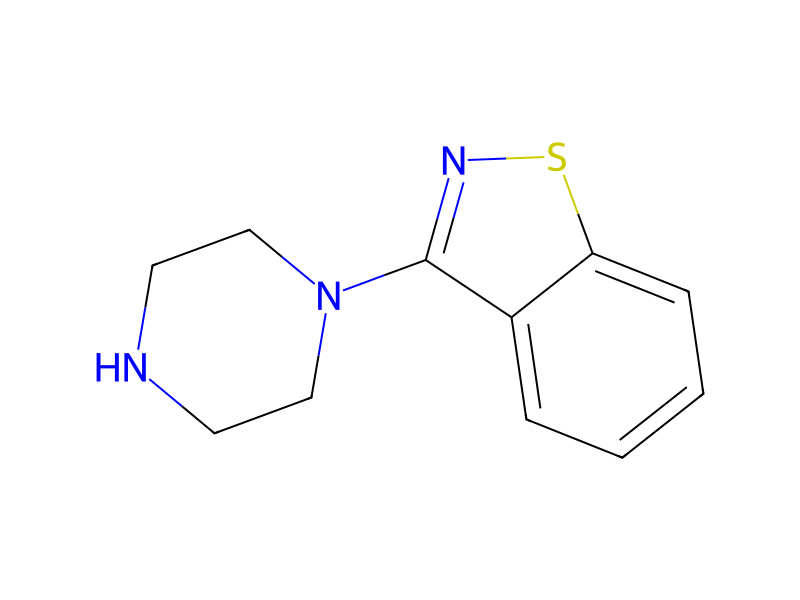

Product 1

Reagents, catalysts & solvents 1

Conditions
- Temperature
- 20 °C
Procedure
U.S. Pat. No. 5,312,925 discloses a process for the preparation of ziprasidone hydrochloride, which involves heating to reflux a mixture of 5-(2-chloroethyl)-6-chloro-oxindole and 1-(1,2-benzisothiazol-3-yl)piperazine in aqueous sodium carbonate for 14 hours, followed by cooling to 20° C. and filtration. The wet product is re-slurried in isopropyl alcohol and filtered, washed with fresh isopropyl alcohol followed by drying under vacuum to get ziprasidone base. The base is then treated with aqueous hydrochloric acid in the presence of water at a temperature of about 60-65° C. for 3 to 24 hours, followed by filtration, washing with water and drying under vacuum to get ziprasidone hydrochloride.
Workup
- temperatureinvolves heating
- temperatureto reflux
- filtrationfiltration
- filtrationfiltered
- washwashed with fresh isopropyl alcohol
- customby drying under vacuum
Sources & evidence
- ORD record
- ord-b3fe1195cc804f14a815670a0b6e0aac
- Source dataset
- uspto-grants-2012_05
- Patent number
- US08178674B2
Reaction notes
Loading…