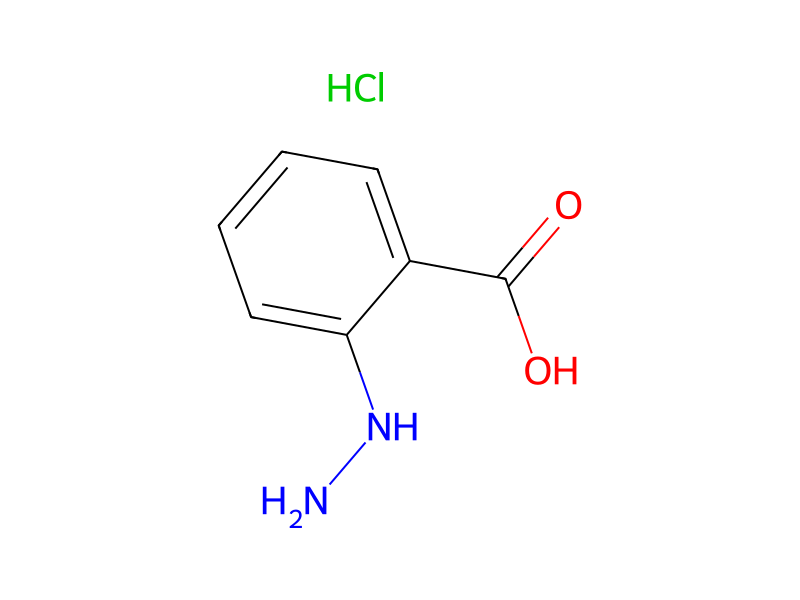
Benzoic acid, 2-hydrazinyl-, hydrochloride (1:1) → 8-Bromo-10H-benzo[4,5]furo[3,2-b]indole-1-carboxylic acid
Reaction equation

[Br:1][C:2]1[CH:3]=[CH:4][C:5]2[O:9][CH2:8][C:7](=O)[C:6]=2[CH:11]=1.Cl.[NH:13]([C:15]1[CH:23]=[CH:22][CH:21]=[CH:20][C:16]=1[C:17]([OH:19])=[O:18])N>C(O)C.O>[Br:1][C:2]1[CH:3]=[CH:4][C:5]2[O:9][C:8]3[C:23]4[C:15](=[C:16]([C:17]([OH:19])=[O:18])[CH:20]=[CH:21][CH:22]=4)[NH:13][C:7]=3[C:6]=2[CH:11]=1Participants
5




Procedure
To a solution of 5-bromo-3(2H)-benzofuranone (3.10 g, 14.6 mmol) [Ellingboe, J. et al., J. Med. Chem. 1992, 35 (7), 1176-1183] in ethanol (100 mL) was added a solution of 2-hydrazinobenzoic acid hydrochloride (5.49 g, 29.1 mmol) in deionized water (200 mL). The mixture was stirred for one hour at room temperature and then allowed to sit while cooled (0° C.). Vacuum filtration and drying in vacuo afforded 3.65 g (72%) of the title compound as a brown solid: mp 195° C. (dec) which was used without further purification.
Workup
- temperaturewhile cooled (0° C.)
- filtrationVacuum filtration
- customdrying in vacuo
Sources & evidence
- ORD record
- ord-a8edaa80c2dd4ee5baaa9978a1764791
- Source dataset
- uspto-grants-2002_05
- Patent number
- US06391902B1
Reaction notes
Loading…