Hydrazine → 2-Hydrazinyl-3-nitropyridine
Reaction equation

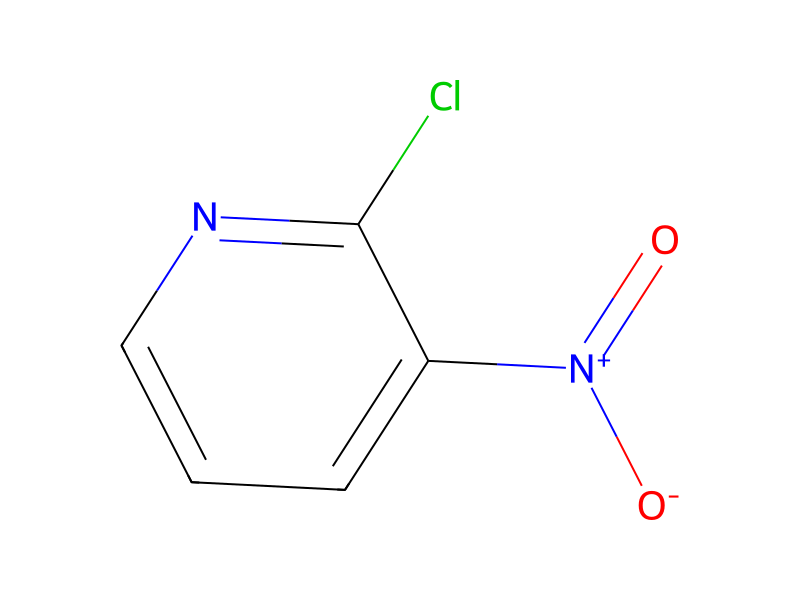
Cl[C:2]1[C:7]([N+:8]([O-:10])=[O:9])=[CH:6][CH:5]=[CH:4][N:3]=1.[NH2:11][NH2:12]>C(O)C>[NH:11]([C:2]1[C:7]([N+:8]([O-:10])=[O:9])=[CH:6][CH:5]=[CH:4][N:3]=1)[NH2:12]Participants
Reactant 2

Product 1

Reagents, catalysts & solvents 1

Procedure
To a suspension of 14.3 g of 2-chloro-3-nitropyridine in 90 mL of anhydrous ethanol was slowly added over 2-3 min with swirling 18 mL of 95% hydrazine. A new solid took the place of the chloro compound as spontaneous warming occurs. After 20 min at room temperature, filtration and washing with ethanol gave 15 g of 2-hydrazino-3-nitropyridine as a straw-yellow solid. To 4 g of the crude hydrazine suspended in 24 mL of anhydrous ethanol was added 16 mL of 95% hydrazine, and the mixture was warmed on a hot plate until the solid dissolved to give a deep red-colored solution and a spontaneous reaction set in with bubbling. The mixture was removed from the source of heat and the reaction allowed to proceed. After 5 min, the mixture was again heated to the boiling point and removed from the hot plate for 5 min. The mixture was treated twice more in this manner after which the deeply-colored solution had become lighter in color (reddish yellow). The solution was evaporated in a warm bath with a water aspirator to a brown oily material which was dissolved in 12 mL of water and acidified (Congo Red) with conc. HCl. Recrystallization from water (Norite) gave 1.10 (31%) of the hydroxytriazole as yellow-colored crystals, mp 203°-211° dec.
Workup
- additionwas slowly added over 2-3 min
- temperatureas spontaneous warming
- filtrationfiltration
- washwashing with ethanol
Sources & evidence
- ORD record
- ord-5600380efe3c442ea4b3fccd86e68005
- Source dataset
- uspto-grants-1997_12
- Patent number
- US05698675
Reaction notes
Loading…