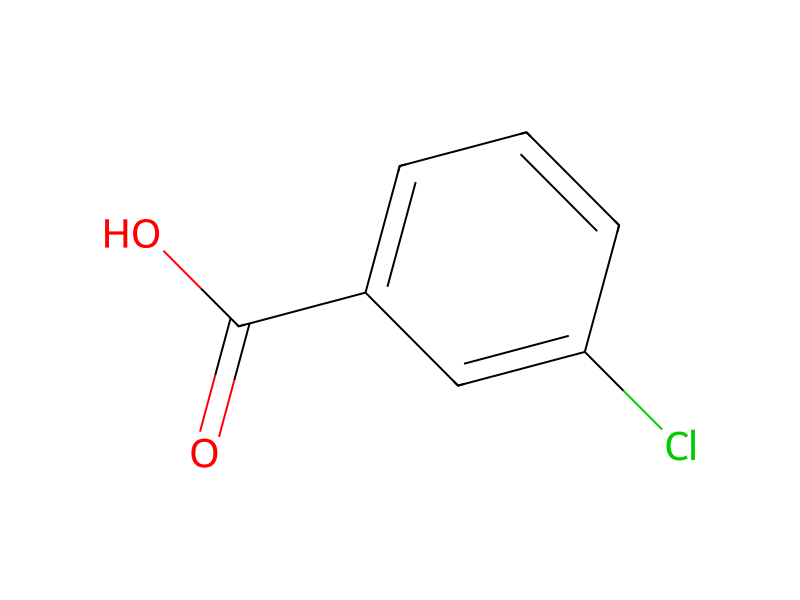
3-Chlorobenzoic Acid → HCID 23500937, compound
Reaction equation

[O:1]1[C:7]23[CH2:8][CH:4]([CH2:5][CH:6]2[CH:9]=[CH2:10])[CH2:3][CH:2]13.ClC1C=C(C=CC=1)C(O)=[O:16]>ClCCl>[O:1]1[C:7]23[CH2:8][CH:4]([CH2:5][CH:6]2[CH:9]=[CH2:10])[CH2:3][CH:2]13.[O:1]1[C:7]23[CH2:8][C:4]4([O:16][CH:3]4[CH:2]12)[CH2:5][CH:6]3[CH2:9][CH3:10]Participants
Reactant 2

Product 2

Reagents, catalysts & solvents 1

Procedure
After stirring 18 hrs at <4° C., KI-starch paper test for peroxide was negative. GC analysis showed little change in product mix: 28% VNB, 44% EVNBA, and 27% diepoxy. After confirming that additional mCPBA would react preferentially with VNB instead of EVNBA, an additional 877 g of mCPBA (for a total of 5085 g, 22.69 mol) was added in three portions as the solid to the reaction mixture. Additional dichloromethane was added only to rinse in the solids. The addition of solid mCPBA caused a temperature drop to 4° C., which was then followed by a gentle exotherm that caused the temperature to rise to 7° C. GC analysis showed 4% VNB, 63% EVNBA, and 32% diepoxy. KI-starch paper test was positive for peroxide. The reaction mixture was stirred an additional 39 hrs at <12° C. KI-starch paper test was negative for peroxide. GC analysis showed 1.4% VNB, 70% EVNBA, and 26% diepoxy isomers. The reaction mixture was split into two portions. 16.4 liters of saturated sodium bicarbonate solution and ˜1 kg of solid sodium bicarbonate was added to each portion. When the solutions did not clear, an additional 1000 g sodium bicarbonate was added to each, followed by 9 L water. The mixtures were stirred for 30 minutes until both had cleared. The phases were separated and the dichloromethane phase was decanted from the undissolved sodium bicarbonate. Each organic phase was washed with 2×16 L brine to pH 7. The undissolved sodium bicarbonate was dissolved with 50 L water, causing separation of ˜4 L of dichloromethane. After separating the phases, the aqueous phase was extracted with 2×4 L dichloromethane. The dichloromethane portions were washed with 2×12 L brine to pH 6. All dichloromethane portions were combined and rotary evaporated to give 2654 g of yellow liquid containing some solids. GC analysis showed 1.0% VNB, 75.7% EVNBA, and 20.2% diepoxy isomers. NMR analysis indicated the composition to be 3.1% m-chlorobenzoic acid, 55.5% EVNBA, 14.6% dichloromethane, and 26.7% diepoxy isomers. The crude product was filtered and then vacuum distilled through a 14-inch Vigreux column to yield 1,002 g (>99%)-3-epoxy-5-vinylnorbornane (EVNBA) and 109.08 (99.6%) 3-epoxy-5-ethylepoxynorbornane (diepoxides).
Workup
- additioncontaining some solids
- filtrationThe crude product was filtered
- distillationvacuum distilled through a 14-inch Vigreux column
Sources & evidence
- ORD record
- ord-7188952918ce40e98999fd3c18995d5b
- Source dataset
- uspto-grants-2013_03
- Patent number
- US08389752B2
Reaction notes
Loading…