Dicyclohexylcarbodiimide → 2,3-Dimethylimidazo[1,2-a]pyrid-7-ylamine
Reaction equation

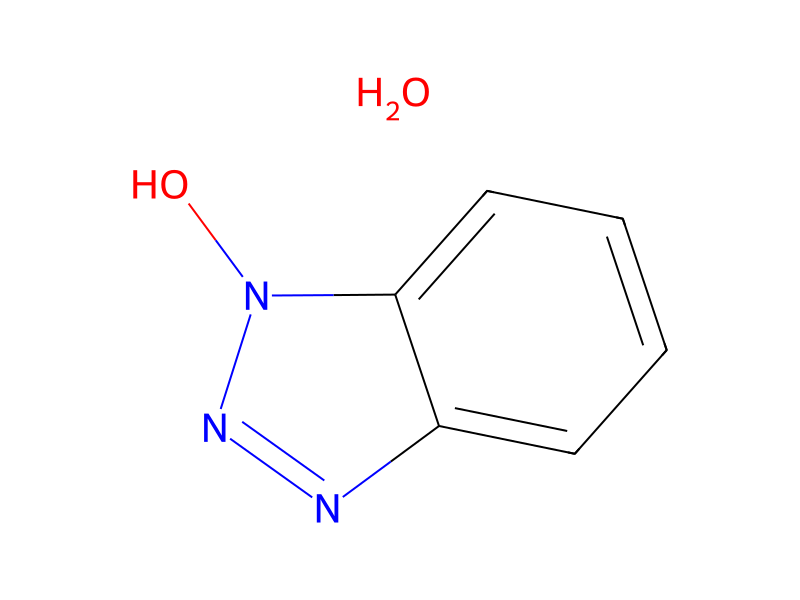
FC(F)(F)C1C=C2C(=CC=1)[N:8](CC1C=CC=C(F)C=1)C(C(O)=O)=C2.[CH:25]1([N:31]=[C:32]=[N:33][CH:34]2[CH2:39][CH2:38]CC[CH2:35]2)[CH2:30][CH2:29][CH2:28]CC1.O.ON1C2C=CC=CC=2N=N1>CN(C=O)C>[CH3:35][C:34]1[N:33]=[C:32]2[CH:28]=[C:29]([NH2:8])[CH:30]=[CH:25][N:31]2[C:39]=1[CH3:38]Participants
Reactant 3


Product 1

Reagents, catalysts & solvents 1

Procedure
To a solution, stirred at 20° C. under an inert atmosphere, of 1 g (2.96 mmol) of 5-trifluoromethyl-1-[(3-fluorophenyl)methyl]-1H-indole-2-carboxylic acid (WO 2006/072736) in 70 mL of DMF are added 0.74 g (3.56 mmol) of dicyclohexylcarbodiimide (DCC) and 0.48 g (3.56 mmol) of 1-hydroxybenzotriazole hydrate (HOBT). The reaction mixture is stirred at room temperature for 30 minutes. 0.7 g (4.45 mmol) of 2,3-dimethylimidazo[1,2-a]pyrid-7-ylamine, obtained according to the protocol described in step 14.4, and 100 mg of dimethylaminopyridine (DMAP) are then added to the reaction mixture. After stirring for 12 hours at 50° C., the reaction mixture is concentrated to dryness. The residue obtained is taken up in a mixture of 50 mL of water and 50 mL of ethyl acetate. The phases are separated by settling and the aqueous phase is extracted with 200 mL of ethyl acetate. The combined organic phases are dried over sodium sulfate and then concentrated under reduced pressure. The product is isolated after successive purifications by chromatography on a column of silica, eluting with a mixture of dichloromethane and methanol. 50 mg of the expected product are thus obtained.
Sources & evidence
- ORD record
- ord-213f7397eaa34f02a432c4529fd7e36f
- Source dataset
- uspto-grants-2013_03
- Patent number
- US08394820B2
Reaction notes
Loading…