2-Bromopyridine → Ethyl 5-(pyridin-2-yl)isoxazole-3-carboxylate
Reaction equation

Br[C:2]1[CH:7]=[CH:6][CH:5]=[CH:4][N:3]=1.C([Sn](CCCC)(CCCC)[C:13]1[O:17][N:16]=[C:15]([C:18]([O:20][CH2:21][CH3:22])=[O:19])[CH:14]=1)CCC.F[P-](F)(F)(F)(F)F.C([N+]1C=CN(C)C=1)CCC>Cl[Pd](Cl)([P](C1C=CC=CC=1)(C1C=CC=CC=1)C1C=CC=CC=1)[P](C1C=CC=CC=1)(C1C=CC=CC=1)C1C=CC=CC=1.O1CCOCC1>[N:3]1[CH:4]=[CH:5][CH:6]=[CH:7][C:2]=1[C:13]1[O:17][N:16]=[C:15]([C:18]([O:20][CH2:21][CH3:22])=[O:19])[CH:14]=1Participants
Reactant 3

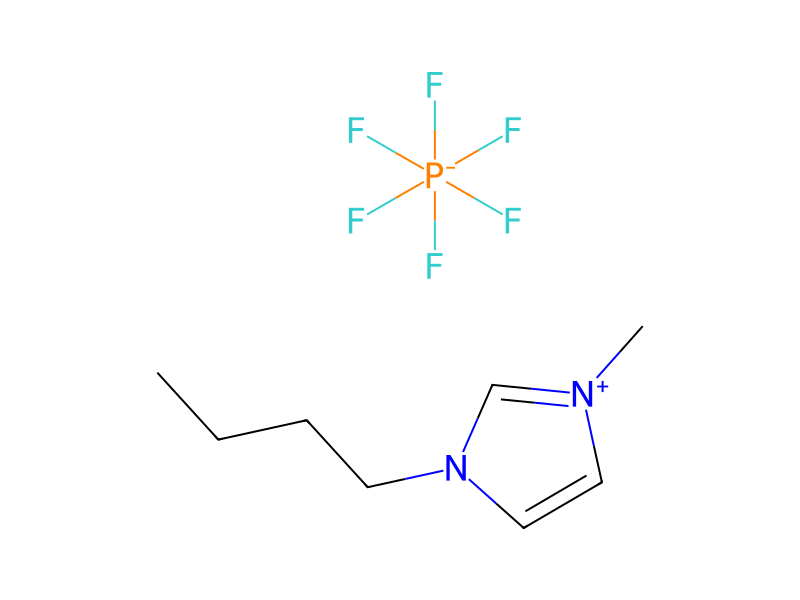

Product 1

Reagents, catalysts & solvents 2


Procedure
A 20 mL BIOTAGE® microwave vial and stir bar were oven dried and cooled under a stream of dry nitrogen. The vial was flushed with argon and charged with dichlorobis(triphenylphosphine)-palladium(II) (96 mg, 0.137 mmol) and dioxane (12 mL) followed by sparging with argon for several minutes. 2-Bromopyridine (0.217 mL, 2.28 mmol), ethyl 5-(tributylstannyl)isoxazole-3-carboxylate (980 mg, 2.28 mmol), and 1-butyl-3-methylimidazolium hexafluorophosphate (0.047 mL, 0.228 mmol) were added and sparging was continued for several minutes. The vial was sealed and processed in a BIOTAGE® microwave at 150° C. for 60 minutes. The solution was cooled, evaporated, and the residue was loaded onto a 120 g Isco silica gel cartridge, which was pre-equilibrated with hexanes, and then eluted with 0-50% EtOAc/Hexanes. The product fractions were evaporated to give a pale yellow oil, which solidified after being placed under high vacuum to afford ethyl 5-(pyridin-2-yl)isoxazole-3-carboxylate (212 mg, 0.972 mmol, 43% yield). The product had an HPLC retention. time=2.48 min.—Column: YMC S5 COMBISCREEN® 4.6×50 mm (4 min.); Solvent A=10% MeOH, 90% H2O, 0.1% TFA; Solvent B=90% MeOH, 10% H2O, 0.1% TFA. LC/MS M+1=219.1. 1H NMR (400 MHz, chloroform-d) δ ppm 1.42-1.48 (m, 3H), 4.49 (q, J=7.28 Hz, 2H), 7.31 (s, 1H), 7.39 (ddd, J=7.53, 4.89, 1.13 Hz, 1H), 7.87 (td, J=7.78, 1.76 Hz, 1H), 7.96 (d, J=7.78 Hz, 1H), and 8.73 (d, 1H).
Workup
- customdried
- temperaturecooled under a stream of dry nitrogen
- customThe vial was flushed with argon
- customby sparging with argon for several minutes
- customsparging
- waitwas continued for several minutes
- customThe vial was sealed
- temperatureThe solution was cooled
- customevaporated
- washeluted with 0-50% EtOAc/Hexanes
- customThe product fractions were evaporated
- customto give a pale yellow oil, which
Sources & evidence
- ORD record
- ord-b2ea9ee5b3984f71a9b2c7872c5f90ac
- Source dataset
- uspto-grants-2013_03
- Patent number
- US08404672B2
Reaction notes
Loading…