Benzene → Esomeprazole
Reaction equation

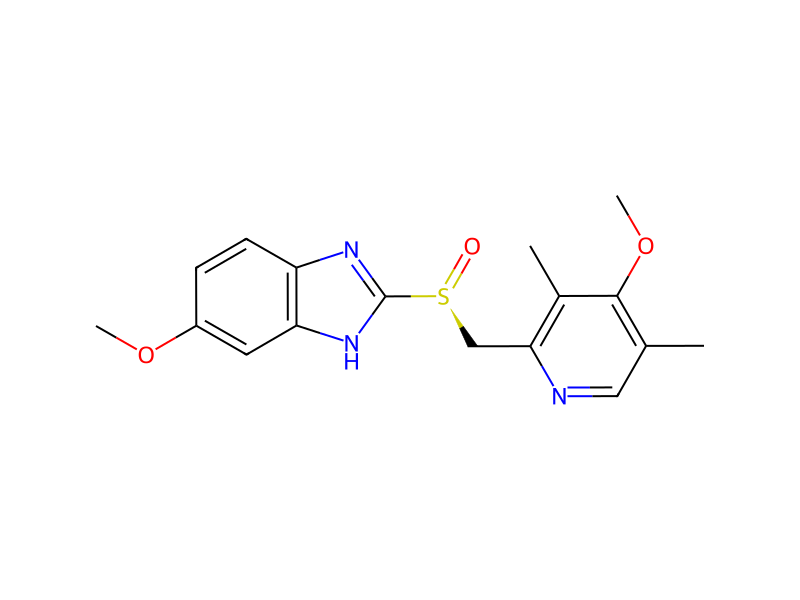
[CH3:1][C:2]1[CH:3]=[N:4][C:5]([CH2:11][S+:12]([O-:24])[C:13]2[NH:14][C:15]3[CH:16]=[CH:17][C:18]([O:22][CH3:23])=[CH:19][C:20]=3[N:21]=2)=[C:6]([CH3:10])[C:7]=1[O:8][CH3:9].C1C=C2C=CC(O)=C(C3C4C(=CC=CC=4)C=CC=3O)C2=CC=1.C1C=CC=CC=1>CCCCCC>[CH3:1][C:2]1[C:7]([O:8][CH3:9])=[C:6]([CH3:10])[C:5]([CH2:11][S@@:12]([C:13]2[NH:21][C:20]3[CH:19]=[C:18]([O:22][CH3:23])[CH:17]=[CH:16][C:15]=3[N:14]=2)=[O:24])=[N:4][CH:3]=1Participants
5
Reactant 3


Product 1
Reagents, catalysts & solvents 1

Procedure
In a later publication in Tetrahedron Asymmetry 11 (2000), 1729-1732 the inventors of the above mentioned Chinese patent application reported the resolution of omeprazole using (S)-BINOL. An inclusion complex of (S)-BINOL and (S)-omeprazole was obtained as a grey-blue complex with 90.3% e.e. by mixing racemate omeprazole and (S)-(−)-BINOL in the mole ratio 1:1.5, in a solvent mixture of benzene:hexane (v/v=4:1) at 110° C. The inclusion complex obtained was further purified by recrystallization in benzene:hexane (v/v, 1:1) and separated on a silica gel column to yield (S)-(−)-omeprazole with 98.9% e.e. and 84.1% overall yield. The (S)-(−)-omeprazole so obtained was recrystallized in water to obtain as a white powder with 99.2% e.e.
Workup
- customat 110° C
- customThe inclusion complex obtained
- customwas further purified by recrystallization in benzene
- customhexane (v/v, 1:1) and separated on a silica gel column
Sources & evidence
- ORD record
- ord-078cc27d42724bfbad327bc3d1b3a479
- Source dataset
- uspto-grants-2013_03
- Patent number
- US08404853B2
Reaction notes
Loading…