Pyridine → diethyl 4-(4-chloro-2-nitrobenzoyl)-1H-pyrazole-3,5-dicarboxylate
Reaction equation

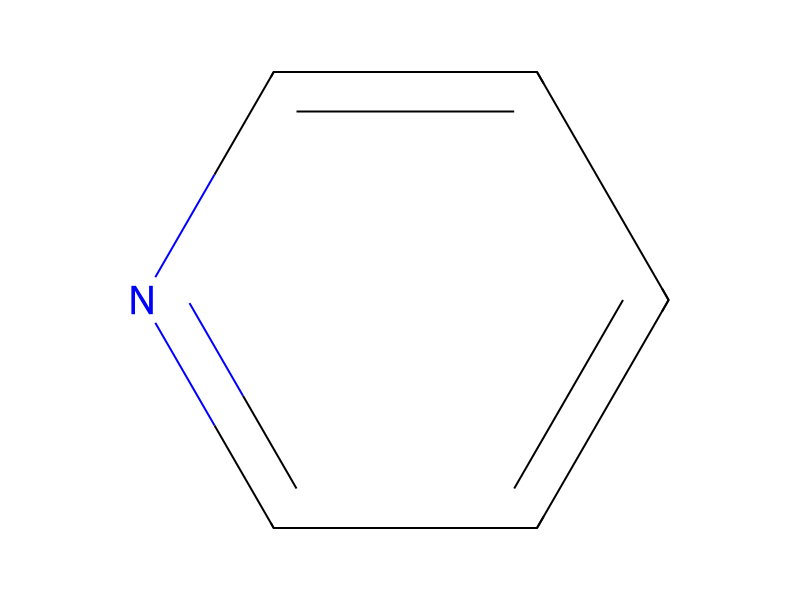
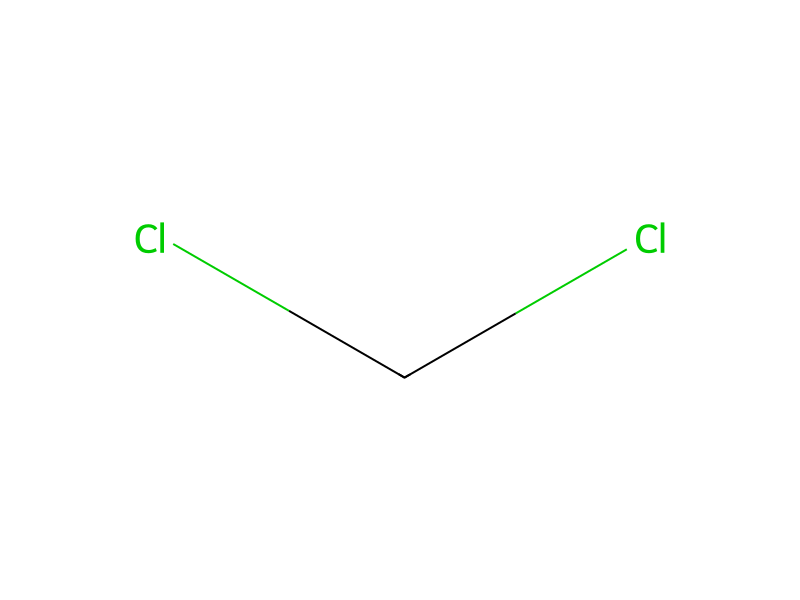
N1C=CC=CC=1.[Cl:7][C:8]1[CH:13]=[CH:12][C:11]([CH:14]([OH:30])[C:15]2[C:16]([C:25]([O:27][CH2:28][CH3:29])=[O:26])=[N:17][NH:18][C:19]=2[C:20]([O:22][CH2:23][CH3:24])=[O:21])=[C:10]([N+:31]([O-:33])=[O:32])[CH:9]=1.O=[Cr](=O)=O.C1C=CC=CN=1.C1C=CC=CN=1>C(Cl)Cl.[O-2].[Cr+6].[O-2].[O-2]>[Cl:7][C:8]1[CH:13]=[CH:12][C:11]([C:14]([C:15]2[C:19]([C:20]([O:22][CH2:23][CH3:24])=[O:21])=[N:18][NH:17][C:16]=2[C:25]([O:27][CH2:28][CH3:29])=[O:26])=[O:30])=[C:10]([N+:31]([O-:33])=[O:32])[CH:9]=1Participants
Reactant 3


Product 1

Reagents, catalysts & solvents 2

Procedure
Pyridine (481.6 g, 6.08 moles) was added dropwise over 35 minutes to a mechanically stirred suspension of chromium (VI) oxide (304.56 g, 3.05 moles) (WARNING: adding pyridine to chromium (VI) oxide is an extremely dangerous procedure and, therefore, chromium (VI) oxide should preferably be added to pyridine) and methylene chloride (6 L) under N2. The reaction as stirred for 40 minutes after pyridine addition was completed and then a solution of diethyl 4-[(4-chloro-2-nitro phenyl)hydroxymethyl]-1H-pyrazole-3,5-dicarboxylate (202.5 g, 0.507 mole) in methylene chloride (1.3 L) was added dropwise over 0.5 hours at room temperature. Stirring at room temperature was continued overnight. CELITE™ (205 g) and additional Collins reagent [chromium (VI) oxide (50 g, 0.5 mole) and pyridine (120.3 g, 1.52 moles, methylene chloride (1 L)] were added and the reaction mixture was stirred for 4 days. The reaction mixture was filtered. The filter cake was washed with methylene chloride (3 L) and filtered. The filtrate and wash liquors were combined and concentrated under water aspirator vacuum. The residue was dissolved in ethyl acetate(2 L) and this solution was filtered through a short column of silica gel (3 L). The filtrate was concentrated under water aspirator vacuum. The solid residue was dissolved in warm toluene (800 mL) and then hexane (800 mL) was added with stirring. The mixture was allowed to cool to room temperature and was then filtered. The filter cake was washed with hexane (2×500 mL), and dried under vacuum at 50° C. to give the title compound as a white powder (186.08 g, 93%).
Workup
- customThe reaction
- stirringStirring at room temperature
- waitwas continued overnight
- additionwere added
- stirringthe reaction mixture was stirred for 4 days
- filtrationThe reaction mixture was filtered
- washThe filter cake was washed with methylene chloride (3 L)
- filtrationfiltered
- washThe filtrate and wash liquors
- concentrationconcentrated under water
- dissolutionThe residue was dissolved in ethyl acetate(2 L)
- filtrationthis solution was filtered through a short column of silica gel (3 L)
- concentrationThe filtrate was concentrated under water
- dissolutionThe solid residue was dissolved in warm toluene (800 mL)
- additionhexane (800 mL) was added
- stirringwith stirring
- filtrationwas then filtered
- washThe filter cake was washed with hexane (2×500 mL)
- customdried under vacuum at 50° C.
Sources & evidence
- ORD record
- ord-c1c55d8742da453aa81cb52547a67f6e
- Source dataset
- uspto-grants-2000_09
- Patent number
- US06124281
Reaction notes
Loading…