N-Methylmorpholine N-oxide monohydrate → 5-Bromo-1-(phenylsulfonyl)-1H-pyrrole-3-carbaldehyde
Reaction equation

[Br:1][C:2]1[N:6]([S:7]([C:10]2[CH:15]=[CH:14][CH:13]=[CH:12][CH:11]=2)(=[O:9])=[O:8])[CH:5]=[C:4]([CH2:16][OH:17])[CH:3]=1.O.C[N+]1([O-])CCOCC1>C(#N)C.[Ru]([O-])(=O)(=O)=O.C([N+](CCC)(CCC)CCC)CC>[Br:1][C:2]1[N:6]([S:7]([C:10]2[CH:15]=[CH:14][CH:13]=[CH:12][CH:11]=2)(=[O:9])=[O:8])[CH:5]=[C:4]([CH:16]=[O:17])[CH:3]=1Participants
Reactant 2


Product 1

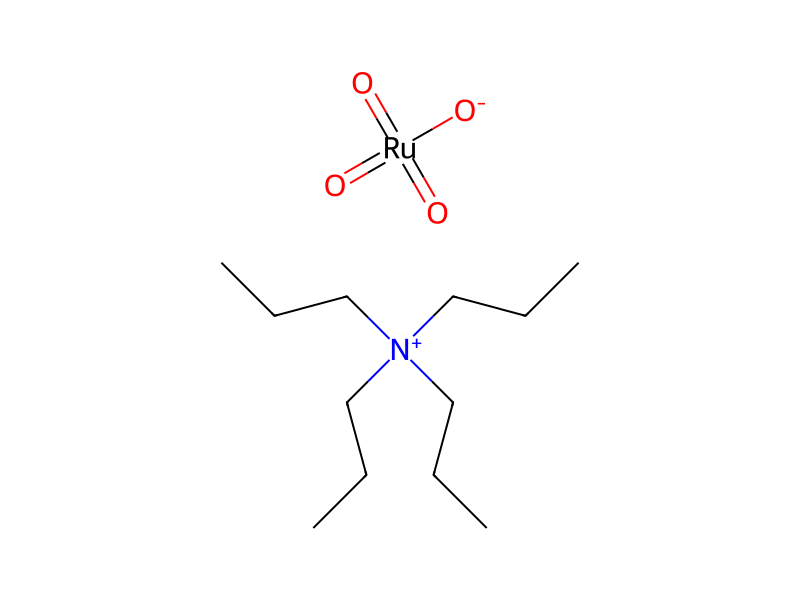
Reagents, catalysts & solvents 2

Procedure
To a solution (80 mL) of [5-bromo-1-(phenylsulfonyl)-1H-pyrrol-3-yl]methanol (7.1 g) in acetonitrile were added tetra-n-propylammonium perruthenate (0.63 g), N-methylmorpholine N-oxide hydrate (4.2 g) and molecular sieves 4A powder (3.5 g), and the mixture was stirred at room temperature for 2 hr. The reaction mixture was filtered, and the filtrate was concentrated under reduced pressure. Water was added to the residue, and the mixture was extracted with ethyl acetate. The extract was washed with saturated brine, dried over anhydrous sodium sulfate, and concentrated under reduced pressure. The residue was purified by silica gel column chromatography (eluent: hexane-ethyl acetate=4:1) to give the title compound as a colorless solid (yield 4.6 g, 71%).
Workup
- filtrationThe reaction mixture was filtered
- concentrationthe filtrate was concentrated under reduced pressure
- additionWater was added to the residue
- extractionthe mixture was extracted with ethyl acetate
- washThe extract was washed with saturated brine
- dry with materialdried over anhydrous sodium sulfate
- concentrationconcentrated under reduced pressure
- customThe residue was purified by silica gel column chromatography (eluent: hexane-ethyl acetate=4:1)
Sources & evidence
- ORD record
- ord-aff38e3e461d4452a295d9786860263a
- Source dataset
- uspto-grants-2013_04
- Patent number
- US08415368B2
Reaction notes
Loading…