Participants
| Role | Name | HCID | Charge |
|---|
| Reactant | Hydrochloric Acid | HCID 313 | — |
| Reactant | Trimethyl borate | HCID 8470 | — |
| Reactant | HCID 68153749 | HCID 68153749 | — |
| Reactant | HCID 178418244 | HCID 178418244 | — |
| Solvent | Tetrahydrofuran | HCID 8028 | — |
| Product | HCID 68154510 | HCID 68154510 | 97% |
Reaction Steps
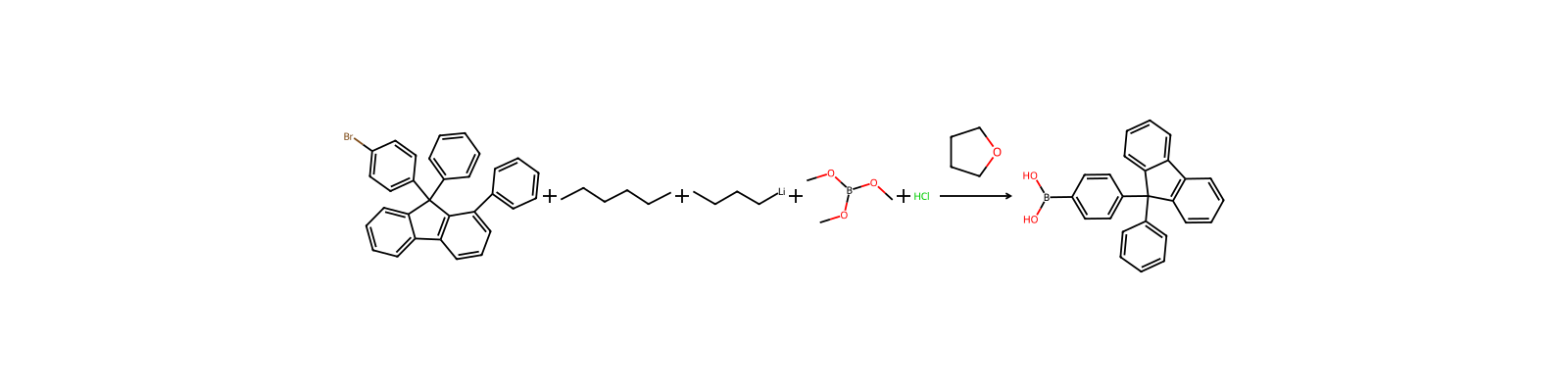
First, 4.0 g (10 mmol) of 9-phenyl-9-(4-bromophenyl)-phenyl-9H-fluorene was put in a 500 mL three-neck flask, the atmosphere in the flask was replaced with nitrogen, 100 mL of dehydrated tetrahydrofuran (abbreviation: THF) was then added to the flask, and the temperature was lowered to −78° C. Into this mixture solution, 7.6 mL (12 mmol) of a 1.59 mol/L n-butyllithium hexane solution was dropped, and the mixture was stirred for 2 hours. To this mixture, 1.4 mL (15 mmol) of trimethyl borate was added, and the mixture was stirred at −78° C. for 2 hours and at room temperature for 18 hours. After the reaction, this reaction solution was stirred while 1M diluted hydrochloric acid was added thereto until the solution became acid. This solution was subjected to ethyl acetate extraction, and an organic layer obtained was washed with a saturated saline. After the washing, magnesium sulfate was added to the organic layer to adsorb moisture. This suspension was filtered, the obtained filtrate was concentrated, and hexane was added thereto. The mixture was irradiated with ultrasonic waves and then recrystallized to obtain 3.5 g of the objective white powder in 97% yield. The reaction scheme of the synthesis method is shown in the following (A-1).
Provenance & Evidence
| DOI | 10.6084/m9.figshare.5104873.v1 |
|---|
| Patent number | US08421346B2 |
|---|
| Source dataset | uspto-grants-2013_04 |
|---|
| ORD ID | ord-8afd584167fb43b4be2809e61aef9ce3 |
|---|
| Source note | uspto-grants-2013_04 |
|---|