HuagongsheHuagongshe Chemistry Print Report · For research reference only
HRID 1968596Generated: October 25, 2026
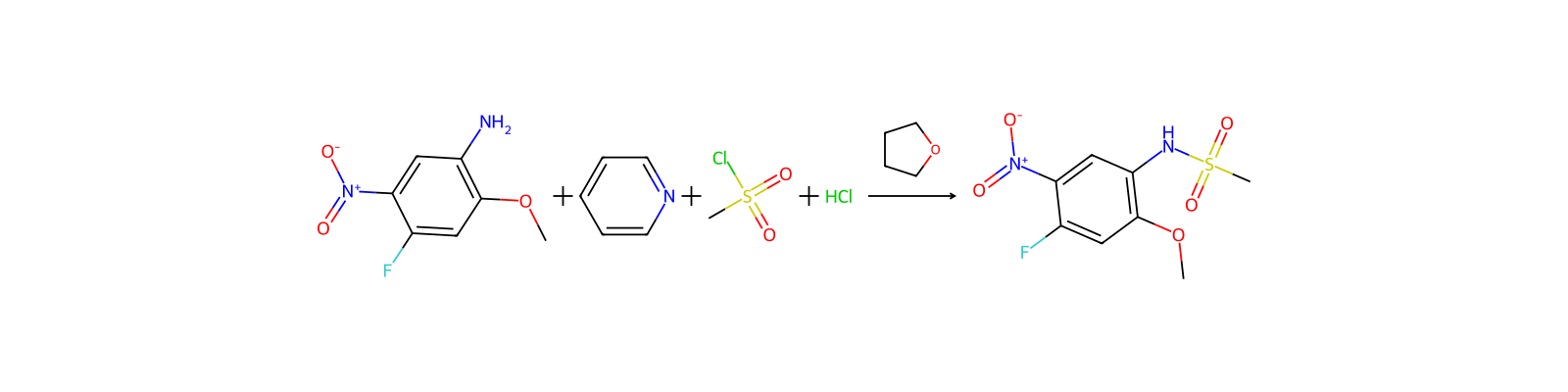
Hydrochloric Acid → 5-Fluoro-2-methanesulfonylamino-4-nitroanisole
https://huagongshe.com/reaction/1968596
Participants
| Role | Name | HCID | Charge |
|---|
| Reactant | Hydrochloric Acid | HCID 313 | — |
| Reactant | Pyridine | HCID 1049 | — |
| Reactant | Methanesulfonyl chloride | HCID 31297 | — |
| Reactant | 4-Fluoro-2-methoxy-5-nitroaniline | HCID 57429072 | — |
| Solvent | Tetrahydrofuran | HCID 8028 | — |
| Product | 5-Fluoro-2-methanesulfonylamino-4-nitroanisole | HCID 57429074 | — |
Reaction Steps
To a solution of 4-fluoro-2-methoxy-5-nitroaniline (0.16 g) and pyridine (0.21 mL) in tetrahydrofuran (3 mL) was added methanesulfonyl chloride (0.074 mL) under ice-cooling, and the mixture was stirred at room temperature for 3 hours, and then stirred at 50° C. overnight. The reaction mixture was poured into 1 mol/L hydrochloric acid, and the resulting mixture was extracted with ethyl acetate. The extract was washed with water and brine, and dried over anhydrous magnesium sulfate. The solvent was removed under reduced pressure, and the residue was purified by column chromatography on silica gel (eluent: n-hexane/ethyl acetate=1/3) to give 5-fluoro-2-methanesulfonylamino-4-nitroanisole (0.1 g). This material was dissolved in N,N-dimethylformamide (3 mL). To the solution were added potassium carbonate (68 mg) and 2,3-difluoro-6-methoxybenzyl bromide (99 mg), and the mixture was stirred at room temperature for 2 hours. The reaction mixture was poured into water, and the resulting mixture was extracted with ethyl acetate. The extract was washed with water and brine, and dried over anhydrous magnesium sulfate. The solvent was removed under reduced pressure, and the residue was purified by column chromatography on silica gel (eluent: n-hexane/ethyl acetate=½) to give 5-fluoro-2-[N-(2,3-difluoro-6-methoxybenzyl)-N-methanesulfonylamino]-4-nitroanisole (0.14 g). This material was dissolved in tetrahydrofuran (2 mL). To the solution was added 10% palladium-carbon powder (13 mg), and the mixture was stirred at room temperature under a hydrogen atmosphere overnight. The insoluble material was removed by filtration, and the filtrate was concentrated under reduced pressure. The residue was purified by column chromatography on silica gel (eluent: n-hexane/ethyl acetate=½) to give the title compound (80 mg).
Provenance & Evidence
| DOI | 10.6084/m9.figshare.5104873.v1 |
|---|
| Patent number | US08426427B2 |
|---|
| Source dataset | uspto-grants-2013_04 |
|---|
| ORD ID | ord-087a7f42080f41c7a45ddf587133450e |
|---|
| Source note | uspto-grants-2013_04 |
|---|