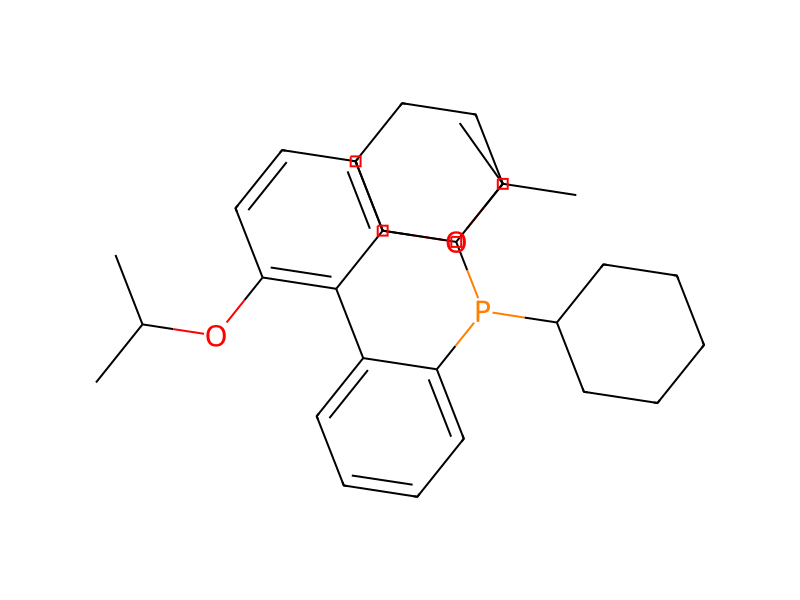
2-Dicyclohexylphosphino-2',6'-diisopropoxybiphenyl → HCID 86670326, compound
Reaction equation

Br[C:2]1[CH:7]=[CH:6][C:5]([C:8]([OH:17])([C:13]([F:16])([F:15])[F:14])[C:9]([F:12])([F:11])[F:10])=[CH:4][CH:3]=1.Cl.[CH2:19]([C@@H:21]1[NH:26][CH2:25][CH2:24][N:23]([C:27]([O:29][C:30]([CH3:33])([CH3:32])[CH3:31])=[O:28])[CH2:22]1)[CH3:20].CC(C)([O-])C.[Na+].C1(P(C2CCCCC2)C2C=CC=CC=2C2C(OC(C)C)=CC=CC=2OC(C)C)CCCCC1>C1C=CC(/C=C/C(/C=C/C2C=CC=CC=2)=O)=CC=1.C1C=CC(/C=C/C(/C=C/C2C=CC=CC=2)=O)=CC=1.C1C=CC(/C=C/C(/C=C/C2C=CC=CC=2)=O)=CC=1.[Pd].[Pd].C1(C)C=CC=CC=1>[CH2:19]([C@@H:21]1[N:26]([C:2]2[CH:7]=[CH:6][C:5]([C:8]([OH:17])([C:13]([F:16])([F:15])[F:14])[C:9]([F:12])([F:11])[F:10])=[CH:4][CH:3]=2)[CH2:25][CH2:24][N:23]([C:27]([O:29][C:30]([CH3:31])([CH3:33])[CH3:32])=[O:28])[CH2:22]1)[CH3:20]Participants
Reactant 4



Product 1

Reagents, catalysts & solvents 2


Conditions
- Temperature
- 100 °C
Procedure
2-(4-bromophenyl)-1,1,1,3,3,3-hexafluoro-2-propanol (0.50 g, 1.5 mmol, Bioorg. Med. Chem. Lett. 2002, 12, 3009), tert-butyl (3S)-3-ethyl-1-piperazinecarboxylate hydrochloride (0.40 g, 1.9 mmol, Acesys Pharmatech, North Brunswick, N.J.), sodium tert-butoxide (0.36 g, 3.7 mmol), dicyclohexyl(2′,6′-diisopropoxybiphenyl-2-yl)phosphine (RuPhos) (0.11 g, 0.23 mmol, Strem Chemical Inc, Newburyport, Mass.), tris(dibenzylideneacetone)dipalladium (0) (0.080 g, 0.077 mmol, Strem Chemical Inc, Newburyport, Mass.), and toluene (3.1 mL) were added to a high-pressure reaction vessel. This mixture was sealed and heated at 100° C. for 29 h. After that time, the reaction mixture was allowed to cool to room temperature and then partitioned between EtOAc (25 mL) and saturated aqueous sodium bicarbonate (10 mL). The layers were separated, the organic material was washed sequentially with saturated aqueous sodium bicarbonate (15 mL) and brine (10 mL), dried (Na2SO4), filtered, and concentrated to give tert-butyl (3S)-3-ethyl-4-(4-(2,2,2-trifluoro-1-hydroxy-1-(trifluoromethyl)ethyl)phenyl)-1-piperazinecarboxylate (0.71 g) as a brown solid. The material was used in the next step without purification.
Workup
- customThis mixture was sealed
- temperatureto cool to room temperature
- custompartitioned between EtOAc (25 mL) and saturated aqueous sodium bicarbonate (10 mL)
- customThe layers were separated
- washthe organic material was washed sequentially with saturated aqueous sodium bicarbonate (15 mL) and brine (10 mL)
- dry with materialdried (Na2SO4)
- filtrationfiltered
- concentrationconcentrated
Sources & evidence
- ORD record
- ord-230804520ba8403bbecd2d5fbab705e8
- Source dataset
- uspto-grants-2013_04
- Patent number
- US08431563B2
Reaction notes
Loading…