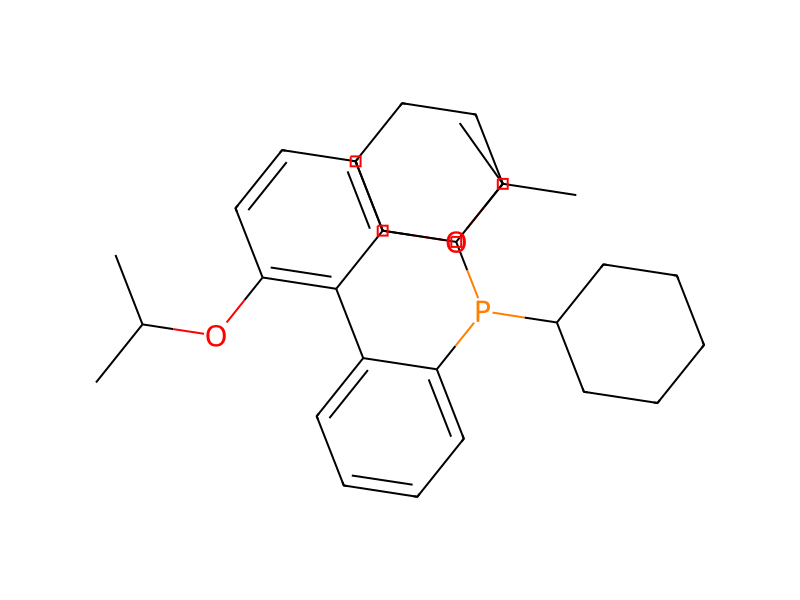
2-Dicyclohexylphosphino-2',6'-diisopropoxybiphenyl → HCID 56932319, compound
Reaction equation

Br[C:2]1[CH:7]=[CH:6][C:5]([C:8]([OH:17])([C:13]([F:16])([F:15])[F:14])[C:9]([F:12])([F:11])[F:10])=[CH:4][CH:3]=1.[CH2:18]([C@@H:25]1[NH:30][CH2:29][CH2:28][N:27]([S:31]([C:34]2[S:35][CH:36]=[CH:37][CH:38]=2)(=[O:33])=[O:32])[CH2:26]1)[C:19]1[CH:24]=[CH:23][CH:22]=[CH:21][CH:20]=1.CC(C)([O-])C.[Na+].C1(P(C2CCCCC2)C2C=CC=CC=2C2C(OC(C)C)=CC=CC=2OC(C)C)CCCCC1>C1C=CC(/C=C/C(/C=C/C2C=CC=CC=2)=O)=CC=1.C1C=CC(/C=C/C(/C=C/C2C=CC=CC=2)=O)=CC=1.C1C=CC(/C=C/C(/C=C/C2C=CC=CC=2)=O)=CC=1.[Pd].[Pd].C1(C)C=CC=CC=1>[CH2:18]([C@H:25]1[CH2:26][N:27]([S:31]([C:34]2[S:35][CH:36]=[CH:37][CH:38]=2)(=[O:32])=[O:33])[CH2:28][CH2:29][N:30]1[C:2]1[CH:7]=[CH:6][C:5]([C:8]([OH:17])([C:13]([F:16])([F:15])[F:14])[C:9]([F:12])([F:11])[F:10])=[CH:4][CH:3]=1)[C:19]1[CH:20]=[CH:21][CH:22]=[CH:23][CH:24]=1Participants
Reactant 4



Product 1

Reagents, catalysts & solvents 2


Conditions
- Temperature
- 100 °C
Procedure
2-(4-bromophenyl)-1,1,1,3,3,3-hexafluoro-2-propanol (0.22 g, 0.68 mmol, Bioorg. Med. Chem. Lett. 2002, 12, 3009), (3S)-3-benzyl-1-(2-thiophenylsulfonyl)piperazine (0.20 g, 0.62 mmol), sodium tert-butoxide (0.19 g, 1.9 mmol), dicyclohexyl(2′,6′-diisopropoxybiphenyl-2-yl)phosphine (RuPhos) (0.058 g, 0.12 mmol, Strem Chemical Inc, Newburyport, Mass.), tris(dibenzylideneacetone)dipalladium (0) (0.057 g, 0.062 mmol, Strem Chemical Inc, Newburyport, Mass.), and toluene (2.5 mL) were added to a high-pressure reaction vessel under a nitrogen atmosphere. The vessel was sealed and was heated at 100° C. for 29 h. Then the mixture was allowed to cool to room temperature and then partitioned between EtOAc (15 mL) and saturated aqueous sodium bicarbonate (10 mL). The layers were separated and the organic material was washed sequentially with saturated aqueous sodium bicarbonate (25 mL) and brine (15 mL), dried (Na2SO4) and filtered. The filtrate was concentrated, and the solution, and the volatiles were removed in vacuo. The residue was subjected purified via column chromatography using silica gel (twice, 100% CH2Cl2, then 25% EtOAc in hexanes) to give of 2-(4-((2S)-2-benzyl-4-(2-thiophenylsulfonyl)-1-piperazinyl)phenyl)-1,1,1,3,3,3-hexafluoro-2-propanol (0.048 g) as a colorless solid. 1H NMR (400 MHz, CDCl3) δ 7.72-7.54 (m, 4H), 7.33-7.14 (m, 6H), 6.94 (d, J=7.2 Hz, 2H), 4.04 (d, J=8.2 Hz, 1H), 3.91 (d, J=9.4 Hz, 1H), 3.75 (d, J=11.2 Hz, 1H), 3.54 (d, J=11.2 Hz, 1H), 3.42 (t, J=10.9 Hz, 1H), 3.31 (br. s., 1H), 3.21 (t, J=11.7 Hz, 1H), 2.67-2.48 (m, 3H); m/z (ESI, +ve ion) 565.0 (M+H)+. GK-GKRP EC50 (NADPH-coupled)=0.308 μM; GK-GKRP EC50 (LC MS/MS)=0.772 μM.
Workup
- customThe vessel was sealed
- temperatureto cool to room temperature
- custompartitioned between EtOAc (15 mL) and saturated aqueous sodium bicarbonate (10 mL)
- customThe layers were separated
- washthe organic material was washed sequentially with saturated aqueous sodium bicarbonate (25 mL) and brine (15 mL)
- dry with materialdried (Na2SO4)
- filtrationfiltered
- concentrationThe filtrate was concentrated
- customthe solution, and the volatiles were removed in vacuo
- custompurified via column chromatography
Sources & evidence
- ORD record
- ord-793c54a9753e497fb1d90d6596285f63
- Source dataset
- uspto-grants-2013_04
- Patent number
- US08431563B2
Reaction notes
Loading…