Ammonium Chloride → 1-Bromo-4-(3,3,3-trifluoroprop-1-en-2-yl)benzene
Reaction equation

[Li][CH2:2]CCC.[Br:6][C:7]1[CH:12]=[CH:11][C:10]([C:13](=O)[C:14]([F:17])([F:16])[F:15])=[CH:9][CH:8]=1.[Cl-].[NH4+]>[Br-].C[P+](C1C=CC=CC=1)(C1C=CC=CC=1)C1C=CC=CC=1.C1COCC1>[Br:6][C:7]1[CH:12]=[CH:11][C:10]([C:13]([C:14]([F:17])([F:16])[F:15])=[CH2:2])=[CH:9][CH:8]=1Participants
Reactant 3



Product 1

Reagents, catalysts & solvents 2
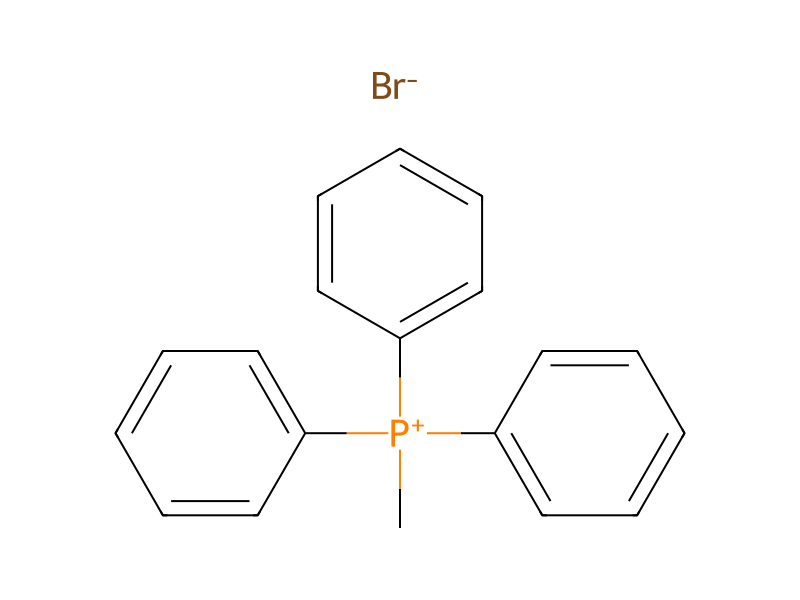

Procedure
n-BuLi (9.5 mL, 2.5 M solution with toluene, 24 mmol) was added to a stirring mixture of methyltriphenylphosphonium bromide (8.5 g, 24 mmol) and THF (100 mL) at room temperature under a nitrogen atmosphere. After 1 h, 1-(4-bromophenyl)-2,2,2-trifluoroethanone (3.0 mL, 20 mmol, Sigma-Aldrich, St. Louis, Mo.) was added. After an additional 1 h, saturated aqueous ammonium chloride (50 mL) was added. The mixture was partitioned between diethyl ether (100 mL) and saturated aqueous ammonium chloride (50 mL). The layers were separated, the organic material was washed sequentially with saturated aqueous ammonium chloride (50 mL) and brine (50 mL), dried (MgSO4), and purified via column chromatography (35 g of silica, 1% EtOAc in hexanes) to provide 1-bromo-4-(1-(trifluoromethyl)ethenyl)benzene (3.5 g) as an orange oil.
Workup
- waitAfter an additional 1 h
- customThe mixture was partitioned between diethyl ether (100 mL) and saturated aqueous ammonium chloride (50 mL)
- customThe layers were separated
- washthe organic material was washed sequentially with saturated aqueous ammonium chloride (50 mL) and brine (50 mL)
- dry with materialdried (MgSO4)
- custompurified via column chromatography (35 g of silica, 1% EtOAc in hexanes)
Sources & evidence
- ORD record
- ord-d534295e0d2e4566a72c20dd27debbf7
- Source dataset
- uspto-grants-2013_04
- Patent number
- US08431563B2
Reaction notes
Loading…